
Church app: does your church need one, and what three options cost
Decide whether your church needs a member app, with a checklist for access, giving, messages and the people who will maintain it.
Every price here was read off the vendor's own page on October 13, 2026.
On this page
A church app is a program members install on their phones to see events, give, join groups and read what the church sends. Most small churches do not need an app of their own in the App Store. A website that works on a phone serves the guest, and a free member app or a text message serves the member who comes back every week. This page shows what the jobs look like and what three paid options cost.
What members use an app for
Members open an app for six jobs. They check Sunday’s time and sermon, give, sign up to serve, ask for prayer, find a group and see what is on the calendar. These two screens, drawn with a sample church, show the first and the most common.
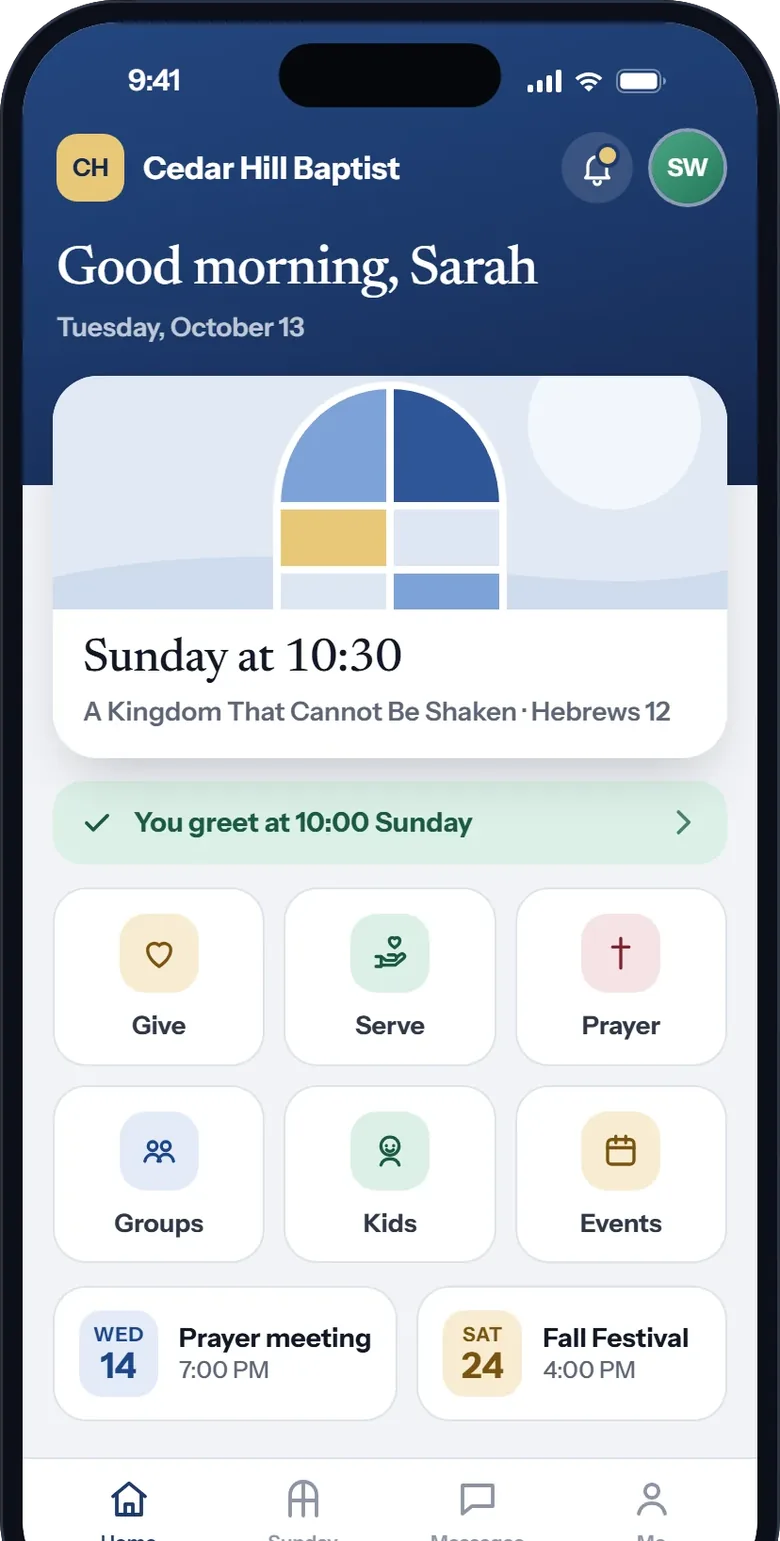
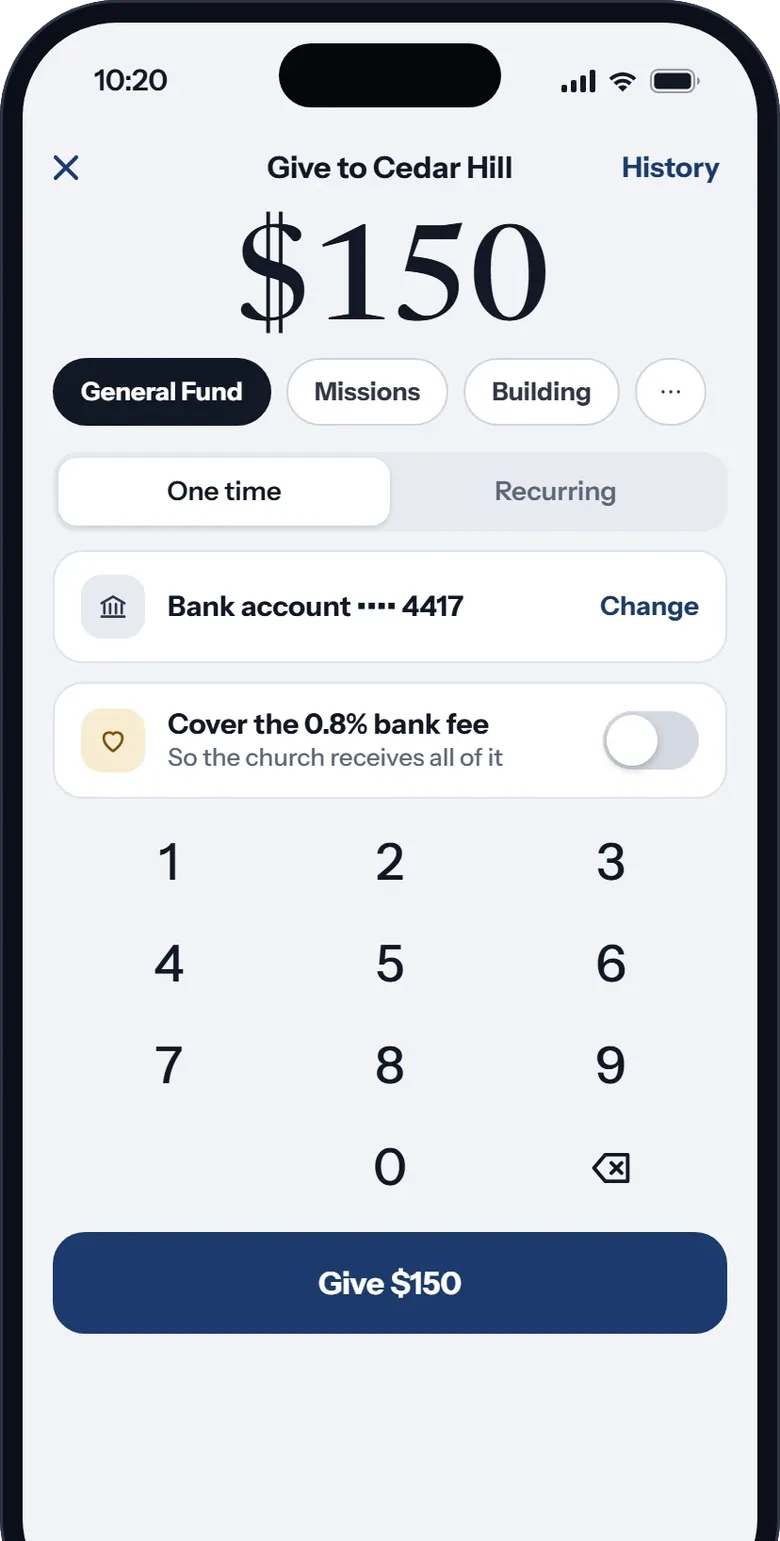
A website can do the same jobs on a phone, and the table shows where it falls short.
| Job | A website on a phone | An app |
|---|---|---|
| Service times and the address | Yes | Yes |
| Sermons and events | Yes | Yes |
| Giving | Yes, through a giving page | Yes, often with the giver’s details saved |
| A message that appears on the phone’s screen, called a push notification | Only with extra setup, and only in some browsers | Yes, for members who install the app and allow it |
| A member directory behind a sign-in | Only if the website has sign-ins | Yes, if the app includes one |
A guest looks for a service time without installing anything, so the website has to work on a phone either way. An app serves members who come back every week.
The cheaper message
The one job an app does that a website cannot is the message on the phone’s screen. A church can send most of those as text messages, which reach every phone with no install. People want the cancellation notice before they leave the house.
Free tool you can try here
Send the message without an app
Choose who gets it and type the message. Free Church Texting sends it from one shared inbox, to every phone.
Cedar Hill, shared inbox
Grace Baptist: Both services are cancelled Sunday, Jan 17, because of ice. The sermon will come by email at 10. We meet as usual next week.
Count us in!
We will be 10 minutes late.
The software is free. A church opens its own Twilio account and pays Twilio’s rates directly, and nothing is added.
Free Church Texting is Church Posting's own product.
Four questions before you buy
- Will members install it and use it? Count how many members you expect to use it in its first year.
- Who will keep it current? Someone has to post the events and the sermons each week.
- Does it come with software the church already uses? Many church management programs include a member app.
- What happens to the members’ accounts and the giving records if you leave? Ask in writing how you would download a copy of them.
What three options cost
Each figure below was read on the company’s own page on October 13, 2026.
| Option | What the page says | Price |
|---|---|---|
| Planning Center Church Center | A member app and web platform that comes with Planning Center | Free |
| Tithely All-Access | One plan that its page says includes giving, apps and websites | $119 a month |
| Subsplash One | A package that includes custom mobile and TV apps | Subsplash says the price is “based on church size and usage” and publishes no figure |
Planning Center’s pricing page lists Church Center as “Free Member app and web platform publishing.” A church that already uses Planning Center has a member app at no extra charge, and a church using other software should look for an app in what it already pays for. The calculator below adds up the yearly cost of the software a church pays for today.
Free tool you can try here
What your software costs for a year
Start with texting, one line of the yearly bill. The full calculator adds church management, giving and streaming.
This free tool is made by Church Posting.
The calculator is free, and the full version adds church management, giving and streaming to the same sheet.
When an app is worth it
An app earns its place when members use it each week, such as for signing up for groups, reading the directory or getting a message about a cancelled service on the phone’s screen. If your church’s needs are the service times, the sermons and a giving page, a website that works well on a phone does the job.
Pages cited
- Planning Center pricing, Planning Center. Read October 13, 2026.
- Free Church Giving + Pricing for ChMS, Websites, and Apps | Tithely, Tithely. Read October 13, 2026.
- Subsplash Pricing & Packages, Subsplash. Read October 13, 2026.
More on software
All software articlesClergy housing allowance: how it works and what the church has to do
How a minister's housing allowance works under IRS Publication 517: the three limits on it, the designation a church makes in advance, Social Security and Medicare tax, and the pastor's W-2.
Church live streaming: three setups, the equipment for each and where to send the stream
How to stream a church service with a phone, one camera or several, with the sound feed, the internet speed YouTube asks for, the song license, and two streaming services' prices read October 13, 2026.
Online giving for churches: what each platform costs in fees
Fees read October 13, 2026 for Planning Center, Tithely, Givelify, Subsplash, Anedot, Zeffy and Stripe, worked out in dollars for a church that receives $100,000 a year in online gifts.
The weekly email
Join the list for the weekly email of new articles, free tools and job postings. It has not started sending yet.