
Church promotion ideas, costed: what brings people through the door
What a postcard drop, a paid social campaign, a door walk, and the funerals you already host cost per first-time visitor. Sourced prices, stated assumptions, and the ideas that waste a Saturday.
On this page
- What your promotion budget is
- What reach costs, three ways
- Postcards: what a mail drop costs
- Paid social: what a lead is not
- The door walk: the only approach with randomized evidence behind it
- What decides, according to the only large survey of the decision
- The genuinely useful thing, and what holding it costs
- The funerals and weddings you already host
- The ideas that waste a volunteer’s Saturday
- The two hours that come before any of it
- The decision
- What to measure, and what not to
- Take the arithmetic with you
Choose a neighborhood, name the people who will do the work and count both cash and volunteer hours before approving outreach. Use the worked examples below to compare a postcard drop, paid social posts, a door walk and existing church events. Record how guests heard about the church so you can compare the plan with the result.
Search for church promotion ideas and you get lists. One of the pages holding page one runs to 101 of them, including a blacklight Easter egg hunt, a helicopter candy drop, and an indoor paintball tournament with a giant inflatable arena in the parking lot (ChurchFuel, 101 Outreach Ideas). Across all 101 there is exactly one price on the page, $20 for 500 foam bullets, and no attendance figure anywhere.
Nobody leaves out the numbers by accident. A number is a liability. A postcard vendor will not tell you that a postcard drop returns a fraction of a percent, an agency will not tell you a Facebook lead is a name rather than a person, and a listicle with a hundred ideas in it cannot stand behind any of them.
So here is the arithmetic instead. Five approaches, priced with figures read off vendor pages and published research this week, with every assumption written where you can argue with it. The honest finding up front: the cheapest thing on the list costs nothing and nobody schedules it, and the thing everyone calls free is the most expensive item in the whole comparison.
Before you spend anything, read reaching a neighborhood for the mapping work. This page assumes you already know who lives in your half mile. If you do not, no budget below will help you.
What your promotion budget is
Start with the size of the church doing the spending.
Median in-person worship attendance at US congregations has risen to 70, the first positive movement in twenty-five years, on responses from 7,453 congregations across 79 denominations surveyed between September and December 2025 (Exploring the Pandemic Impact on Congregations, Signs of Rebound Amid Uneven Recovery). That is the church in this conversation. Not the one with eleven staff.
A church of seventy has perhaps twelve adults who will give a Saturday morning twice a year, and no line item for advertising. Which means the only two currencies available are a small amount of cash and a fixed number of volunteer hours.
Volunteer hours have a price. Independent Sector, working with the Do Good Institute at the University of Maryland, put the value of a volunteer hour at $36.14 for 2025, up 3.9 percent on 2024, computed from Bureau of Labor Statistics average hourly earnings for production and non-supervisory workers on private non-farm payrolls plus fringe benefits (Independent Sector, Value of Volunteer Time, announced 21 April 2026).
Nobody writes a check for that. It is still the right number to use, for one reason: the same twelve people are the ones who staff the nursery, run the sound, count the offering, and clean the kitchen. An afternoon spent on a promotion idea is an afternoon not spent on something else, and pricing it is the only way to see the trade you are making. If you have never audited what the calendar already takes from those twelve people, what fills a church calendar is the prerequisite for this page.
So every approach below gets costed twice. Once in cash, which is what a treasurer sees. Once with the volunteer hour priced in, which is what happened.
What reach costs, three ways
Reach is the only part of this that has published prices. Here is what it costs to put something in front of a fixed number of homes.
- Postcards by mail postage plus printing
- Cards walked by members printing only
- Paid social impressions an impression, not a hand
Postage at the USPS EDDM Retail rate of $0.26 a piece, read from usps.com on 29 July 2026. Printing at the midpoint of published 6.5 by 9 inch postcard tiers: $250 at 2,500 pieces, $360 at 5,000, $560 at 10,000. The 1,000-home mail figure carries a 2,500-piece minimum print order, which is why mailing 1,000 homes costs more than half of what mailing 2,500 costs. Paid social derived from a $1.65 cost per click at a 1.86 percent click-through rate, which implies $30.69 per thousand impressions.
See the numbers
| Vendor | 1,000 people | 2,500 people | 5,000 people | 10,000 people |
|---|---|---|---|---|
| Postcards by mail | $510 | $900 | $1,660 | $3,160 |
| Cards walked by members | $250 | $250 | $360 | $560 |
| Paid social impressions | $31 | $77 | $153 | $307 |
Three things fall out of that chart, and the third is the one that matters.
Mailing 1,000 homes is barely cheaper than mailing 2,500. The print minimum sets the floor. If you are going to mail at all, mail the whole half mile.
Walking the cards instead of mailing them removes about 80 percent of the cash cost at 5,000 homes, because postage is $1,300 of the $1,660 and volunteers are not charged postage.
Paid social impressions are the cheapest unit of reach and the weakest. Three hundred dollars puts an image in front of 10,000 people, which sounds like a bargain until you notice what you bought. A postcard is in somebody’s hand. An impression is a rectangle that passed through a phone. The chart puts them on one axis because the money is comparable. What you get for it is not.
Postcards: what a mail drop costs
USPS Every Door Direct Mail Retail runs $0.26 per piece for USPS Marketing Flats, and the program takes between 200 and 5,000 pieces per day per ZIP code (USPS, Every Door Direct Mail, checked 29 July 2026). A commercial mail house quotes the same postage at $0.247 (Cornerstone Services, USPS EDDM postage rates 2026). Use the higher figure, because the USPS page is the one that governs.
Printing a 6.5 by 9 inch postcard on 100 lb gloss runs $320 to $400 at 5,000 pieces, and design, if you pay for it, runs $150 to $350 one time. The same mail house prices a complete 5,000-piece campaign with design at about $1,795, or $0.36 a piece. Our arithmetic without design comes to $1,660. Those two numbers bracket each other, which is a good sign.
Then there is the part the price list omits. EDDM Retail requires you to bundle the pieces in stacks of 50 to 100 no higher than six inches, attach a facing slip to every bundle, complete PS Form 3587, and drive the pallet to a specific Post Office on a booked date. That is an afternoon of somebody’s life, and it is not on any invoice.
Now the response rate, which is where every page in this SERP goes quiet.
No independent source publishes a response rate for church direct mail. None. The closest measured number for cold mail from any field is the New Haven voter mobilization experiment, where each direct mailing raised turnout by 0.5 percentage points, against 8.7 points for a face-to-face conversation and no measurable effect at all from phone calls (J-PAL, The Effects of Canvassing, Phone Calls, and Direct Mail on Voter Turnout, Gerber and Green, 29,380 registered voters).
Voting takes fifteen minutes, is socially expected, and is being asked of somebody already registered to do it. Walking into an unfamiliar church for the first time is a far larger ask of a total stranger. So treat 0.5 percent as a ceiling you will not reach, not a forecast.
At 0.5 percent, 5,000 postcards produce 25 people and cost $66 each. At 0.1 percent they produce 5 people and cost $332 each. Both numbers assume every one of those people walks in, which requires the rest of your front door to work.
Paid social: what a lead is not
The published benchmark closest to a church is Education and Instruction, where a leads-objective Facebook campaign runs $1.65 per click, $28.22 per lead, a 1.86 percent click-through rate, and a 10.08 percent conversion rate (LocaliQ, Facebook advertising benchmarks, last updated 24 October 2025). Arts and Entertainment is cheaper at $1.08 per click and $18.17 per lead.
Say the caveat out loud: there is no religion row and no nonprofit row in that data. Anyone quoting you a church-specific Facebook cost per lead is quoting a number that does not exist in any published benchmark. Education is a defensible stand-in and it is still a stand-in.
A lead there means a form completion. Somebody typed an email address. Whether that person then finds parking on a Sunday morning is an entirely separate event that no benchmark measures. If one in two shows up, a first-time visitor costs $56. If one in five shows up, $141.
Paid social is worth buying for exactly one job: putting a specific dated event in front of people who live within a few miles, when you have somewhere for them to land. It is not worth buying to raise awareness of a church, because awareness is not the constraint. Read church social media strategy for what the unpaid feed is for, which is a different question with a different answer.
The door walk: the only approach with randomized evidence behind it
Here the research is unusually good, because political scientists have spent thirty years testing exactly this mechanism.
In the New Haven field experiment, canvassers were sent to 4,509 households with 23,921 held back as a control. They reached 35.60 percent of the households they were assigned. Turnout among those reached was 59.19 percent against 44.63 percent in the control group, and the authors estimate a personal contact raises the probability of turnout by six to seven points. They cost a contact at roughly a dollar, on the basis of ten successful contacts per canvasser-hour, and conclude that sixteen contacts produce one additional voter, at about $16 per voter (Gerber and Green, Does canvassing increase voter turnout? A field experiment).
Ten contacts an hour at a 35.6 percent answer rate means about 28 doors attempted per canvasser-hour. Run that against twelve volunteers for three hours:
- 36 volunteer hours
- about 1,000 doors
- about 356 conversations
- $250 of card stock, because the smallest print run most shops quote is 2,500
Cash cost: $250 for 356 conversations, or seventy cents a conversation. Nothing else in this comparison is close.
Cost with the Saturday priced in: 36 hours at $36.14 is $1,301, so $1,551 all in, or $4.36 a conversation.
Now the assumption you cannot source, so state it. Voting is a much smaller ask than a first church visit, so the sixteen-contacts-per-voter figure does not transfer. If one conversation in twenty produces a visit, the walk yields about 18 visitors. If one in a hundred, about 4. That band is a judgment, and it is the widest uncertainty on this page.
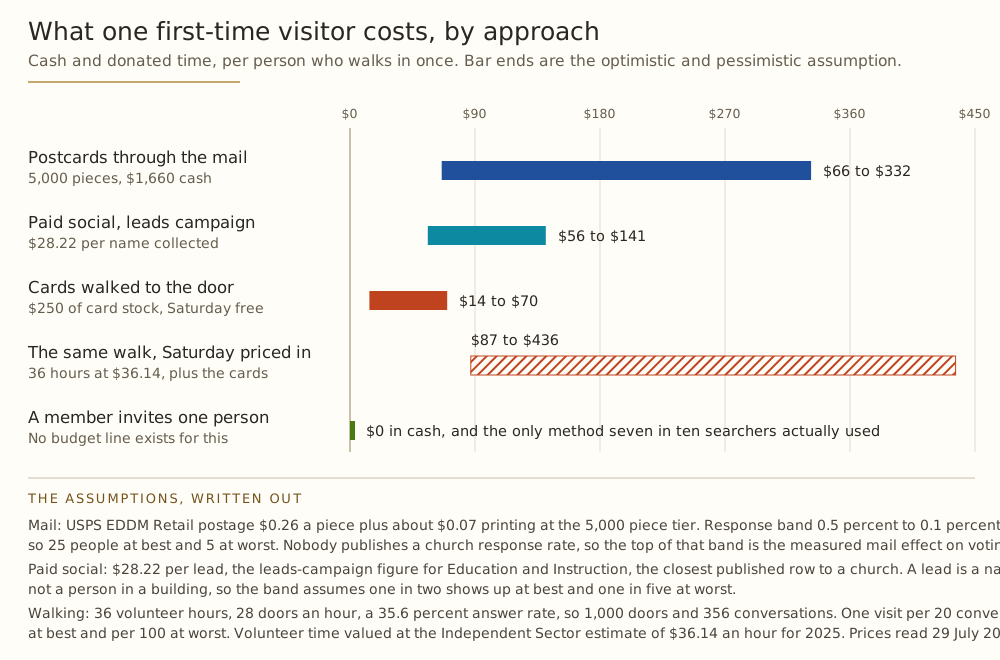
Look at rows three and four together. Judged on cash, walking the neighborhood is five to twenty times cheaper per visitor than mailing it. Judged on total cost, it is the most expensive thing here. Both are true, and which one governs depends on a question only your leadership can answer: are those thirty-six hours genuinely spare, or are you moving them off something that was already working?
What decides, according to the only large survey of the decision
When Pew Research Center surveyed more than 35,000 adults about looking for a new congregation, the mechanics came out like this (Pew Research Center, Choosing a New Church or House of Worship, 23 August 2016):
- 85 percent attended worship services during the search
- about seven in ten spoke with members of the congregation or with friends and colleagues
- 83 percent said the quality of preaching played an important role
- about three quarters said the style of worship mattered
- seven in ten said location mattered
- 56 percent said the quality of children’s programs mattered
- 59 percent of adults under 30 used online searches, against 12 percent of those 65 and older
Read that list against the postcard budget. Preaching, welcome, worship style, location, and children’s programs are five of the six things that decided it, and a promotion budget cannot touch any of them. The sixth is a conversation between two people, which is free and unbuyable.
That is the cheapest row on the chart and the one no church schedules. A member inviting one specific person to one specific service costs nothing and matches the method most searchers used. The reason it does not happen is not cost or conviction. It is that most members have nothing concrete to invite anybody to, with a date, a time, and an address. Fix that first, in the words that church announcement examples uses, and you have spent zero dollars on the highest-yield method available.
The genuinely useful thing, and what holding it costs
An unlocked building with the lights on, at the same hour every week, staffed by two people who are glad you came, with coffee and a working restroom.
That beats every event on every listicle, for a reason that has nothing to do with marketing. A neighborhood can learn a schedule. It cannot learn a festival. A one-day event in June is forgotten by August, and the church that ran it has spent its entire volunteer budget for the quarter on a memory.
Price it honestly. Two people, three hours, fifty weeks is 300 donated hours, which is $10,842 at the Independent Sector figure. Cash cost is coffee. That is by far the largest number on this page and it buys the only thing that compounds.
Three rules decide whether it survives past March.
One fixed hour, written down, with four names on it. Two people plus two substitutes. Not “most weeks”. A door that is sometimes locked is worse than a door that was never opened, because now the neighborhood has tested you.
Solve one specific problem, chosen from what the walk told you. Tutoring on school nights. A pantry with actual hours. Winter coats sized for children rather than adult mediums. Pick the problem the neighborhood named, not the one that photographs well.
No sales step attached to the coffee. A back-to-school giveaway that requires sitting through a presentation to receive the backpacks costs you the neighborhood’s trust permanently, and the neighborhood detects the swap immediately.
The funerals and weddings you already host
This is the part every promotion listicle skips, and it is the largest unstaffed front door most churches own.
A funeral fills a room with people who did not choose to come, are paying close attention, and will remember for years how they were treated. No campaign produces that. The family produces it. The church’s only job is to be good at hosting, and almost none of them have written down how.
Two facts should shape the policy before it is written. Cremation was projected to reach 63.4 percent of US dispositions in 2025 against 31.6 percent burial, on a path to 82.3 percent by 2045, and 58.3 percent of people surveyed had attended a funeral in a non-traditional location. The national median cost of a funeral with viewing and burial was $8,300 in 2023, and $6,280 with cremation (National Funeral Directors Association, Statistics). A church that is rigid about caskets, timing, and reception space has opted out of most of the funerals happening within a mile of it.
Weddings tell the same story faster. Religious institutions hosted 22 percent of US weddings in 2017, down from 41 percent in 2009, on figures The Knot supplied and Lifeway Research reported. Banquet halls took 17 percent, barns and farms 15 percent, historic homes 14 percent, hotels and country clubs 12 percent each. Over the same stretch, couples using a friend or family member as officiant went from 29 percent to 43 percent (Lifeway Research, Why No One May Be Getting Married at Your Church This Summer, 31 May 2018).
Those two lines are not a culture war. They are a service problem. What decides whether a family books your building is the fee schedule, the rehearsal policy, whether the reception space can hold a meal, and how fast somebody returns a phone call. All four are within your control and none of them cost money to fix.
So write the hosting standard. Decide once, on paper: whether you host for non-members, what you charge, who the named contact is, how fast they reply, who unlocks and cleans and runs the sound, who meets the family at the curb, who makes coffee and for how many, who prints the order of service, and who calls the family at two weeks and again at one year. A printed order of service that tells a stranger when to stand is doing more work in that room than a year of postcards, and the templates in church bulletin templates and order of worship already cover the layout.
The cash cost of all of that is coffee and paper. The reason it does not happen is that nobody owns it.
The ideas that waste a volunteer’s Saturday
Named, because a page that only recommends is not much use.
The mass mailer to five thousand strangers. Priced above at $66 to $332 per visitor, and the low end of that range assumes a response rate no church has ever published. If you have $1,660, the fixed weekly shift buys you a year of coffee and the walk buys you 356 conversations twice over.
Phone campaigns. The New Haven experiment found no statistically significant turnout effect from phone calls at all, while the same message delivered at a door moved 8.7 points. A phone tree is the cheapest way to feel busy.
The one-day attractional event. A blacklight egg hunt, a candy drop from a helicopter, a carnival. These draw a crowd and produce almost nobody, because a person drawn by a production expects a production, and your ordinary Sunday two weeks later will disappoint them. Advertise what happens every week or advertise nothing.
Launch Sundays with a series title and a graphics package. Copying a megachurch playbook at one fortieth of the staff. Their model assumes eleven employees and a production budget. Yours assumes twelve volunteers and a Saturday.
Anything that requires a consultant to interpret the result. If you cannot explain what happened to a deacon in two sentences, it did not happen.
Buying reach before the follow-up exists. This one is the expensive mistake, because it fails silently. If nobody contacts a first-time visitor within 72 hours, every dollar spent on reach is spent twice: once to get the person in the door and once to lose them. Build the guest follow-up system before you buy a single postcard.
The two hours that come before any of it
Both cost nothing and both outrank every paid option on this page.
The front page of the website states the service time, the street address, and one plain sentence about what happens in that hour. Fifty-nine percent of searchers under 30 used online search during their decision. If your site makes them hunt for a service time, the paid campaign that sent them there was a donation. Website options for a small church covers the five pages that carry it.
The Google Business Profile is claimed and correct. Google states plainly that “you can add or claim your business at no charge” (Google Business Profile Help). Wrong hours on that profile turn every other effort into a person standing at a locked door on a Wednesday evening.
Two hours. No money. Check both twice a year.
The decision
You have thirty-six volunteer hours and a few hundred dollars. Here is where they go.
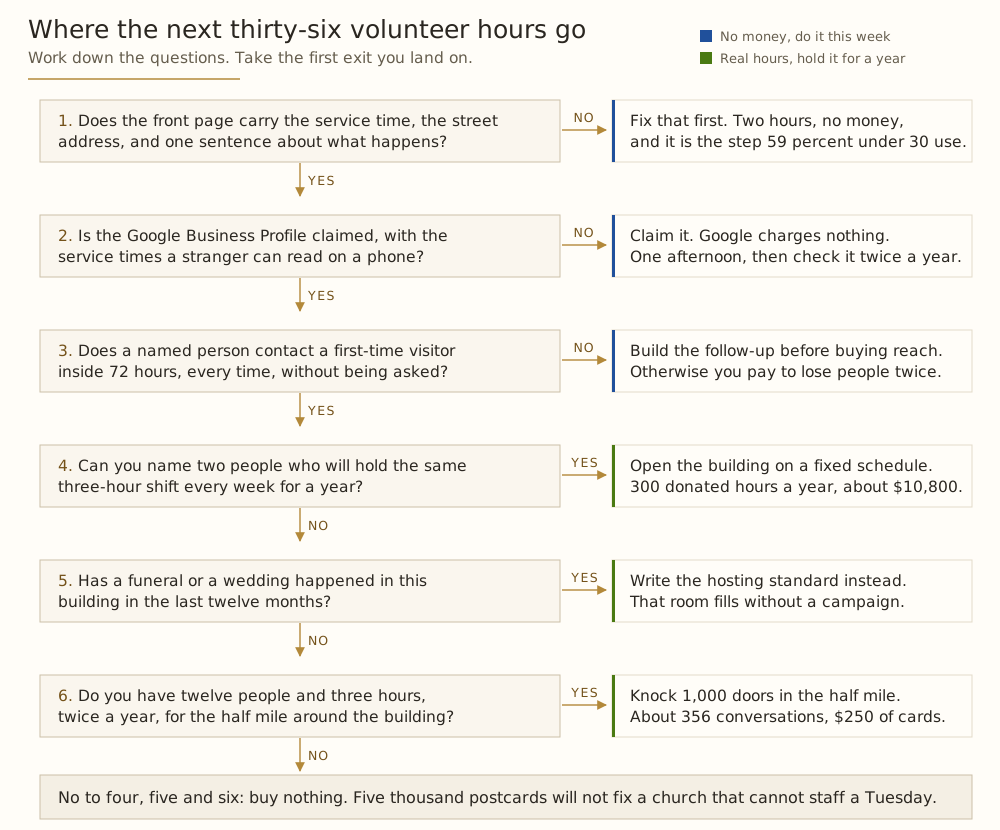
Worked all the way down and answered no to the last three? Then the answer is to buy nothing this quarter. Five thousand postcards will not fix a church that cannot staff a Tuesday, and spending the money anyway converts a staffing problem into a staffing problem plus $1,660.
What to measure, and what not to
Do not judge any of this by Sunday attendance. The link is real and slow, and forcing it turns service into recruitment. Count four things, quarterly, and count them by name:
- Hours the building was open and staffed for something other than worship or member programs
- Neighbors served, counted honestly rather than estimated upward
- Members involved, by name. If the same six appear every quarter, six people are doing this and the church is not
- Named relationships, meaning neighbors a member knows well enough to notice when they are absent
The fourth number moves in single digits per year and it is the only one worth watching closely. For the Sunday side of the ledger, use a method that does not flatter you: measuring church attendance honestly sets out how.
Take the arithmetic with you
Both files are plain text and both open in anything.
The cost per visitor model, as a CSV holds every row of the range chart with its cash cost, volunteer hours, contact rates and per-visitor arithmetic, plus a block of sourced unit prices and the randomized canvassing rates behind them. Replace the unit prices with quotes from your own printer and your own local wage and the per-visitor columns rebuild. Blank cells are numbers nobody has published and are left blank deliberately.
The thirty-six hour plan is the printable version: route splitting for the door walk, the thirty seconds to say at a door, the four things that go on the card, what never to say, the per-address recording table, the signed commitment for a fixed weekly shift, and the eleven questions the funeral and wedding hosting standard has to answer.
Sources
Every figure above was read from these pages on 29 July 2026.
- USPS, Every Door Direct Mail. EDDM Retail postage of $0.26 per piece for USPS Marketing Flats, the 200 to 5,000 pieces per ZIP code per day limits, and the bundling and PS Form 3587 requirements. Checked 29 July 2026.
- Cornerstone Services, USPS EDDM postage rates 2026. Printing tiers for 6.5 by 9 inch postcards, design cost, and the $1,795 all-in figure for a 5,000-piece campaign. Checked 29 July 2026.
- Independent Sector, Value of Volunteer Time. The $36.14 volunteer hour for 2025 and its BLS derivation. Checked 29 July 2026.
- Exploring the Pandemic Impact on Congregations, Signs of Rebound Amid Uneven Recovery. Median in-person worship attendance of 70, from 7,453 congregations across 79 denominations surveyed September to December 2025. Checked 29 July 2026.
- Gerber and Green, Does canvassing increase voter turnout? A field experiment. The 35.60 percent contact rate, the turnout figures, ten contacts per canvasser-hour, and sixteen contacts per additional voter. Checked 29 July 2026.
- J-PAL, The Effects of Canvassing, Phone Calls, and Direct Mail on Voter Turnout. The 8.7 point canvassing effect, 0.5 points per mailing, and no measurable phone effect, across 29,380 registered voters. Checked 29 July 2026.
- LocaliQ, Facebook advertising benchmarks. Cost per click, cost per lead, click-through rate and conversion rate by industry, last updated 24 October 2025, with no religion or nonprofit row. Checked 29 July 2026.
- Pew Research Center, Choosing a New Church or House of Worship, 23 August 2016. How more than 35,000 adults searched and what decided it. Checked 29 July 2026.
- National Funeral Directors Association, Statistics. Median funeral costs for 2023, the 2025 cremation and burial projections, and the non-traditional location figure. Checked 29 July 2026.
- Lifeway Research, Why No One May Be Getting Married at Your Church This Summer, 31 May 2018. Venue shares from The Knot and the officiant trend. Checked 29 July 2026.
- Google Business Profile Help, Add or claim your business profile. That a profile can be added or claimed at no charge. Checked 29 July 2026.
- ChurchFuel, 101 Outreach Ideas You Have Probably Never Heard Of. The ideas named in the opening, and the single price and zero attendance figures across all 101. Checked 29 July 2026.
Two things were looked for and not found, so no claim rests on them. There is no published response rate for church direct mail from any independent source, and there is no religion or nonprofit row in any published Facebook advertising benchmark. Where a number was needed in either place, this page uses a stated assumption and says so.
More on outreach
All outreach articlesChurch Job Descriptions: How to Write One, With Templates
How to write a church job description: templates for pastor, youth, worship, kids, office and tech roles, with data from 379 postings read Oct. 19, 2026.
Church Job Interview Questions: Candidates and Committees
Interview questions for church jobs, for candidates and search committees, with questions by role, a score sheet and the facts postings leave out.
Church Staff Salaries 2026: Pastors and Every Other Role
What churches pay pastors, youth, worship, kids, office and media staff, from 379 job postings read Oct. 19, 2026, BLS wages and denominational surveys.
The weekly email
Join the list for the weekly email of new articles, free tools and job postings. It has not started sending yet.