Social media for a church with no media team
A 45 minute weekly workflow for one volunteer with a phone: an eight shot capture list, batch captions, verified free-tier tools, and why the child photo rule is your policy rather than federal law.
Updated
Most churches under 200 people have no videographer, no designer, and no communications staff. They have one volunteer with a phone and about forty-five minutes a week. That is enough to run a credible church account, as long as the workflow assumes forty-five minutes rather than pretending it has four hours.
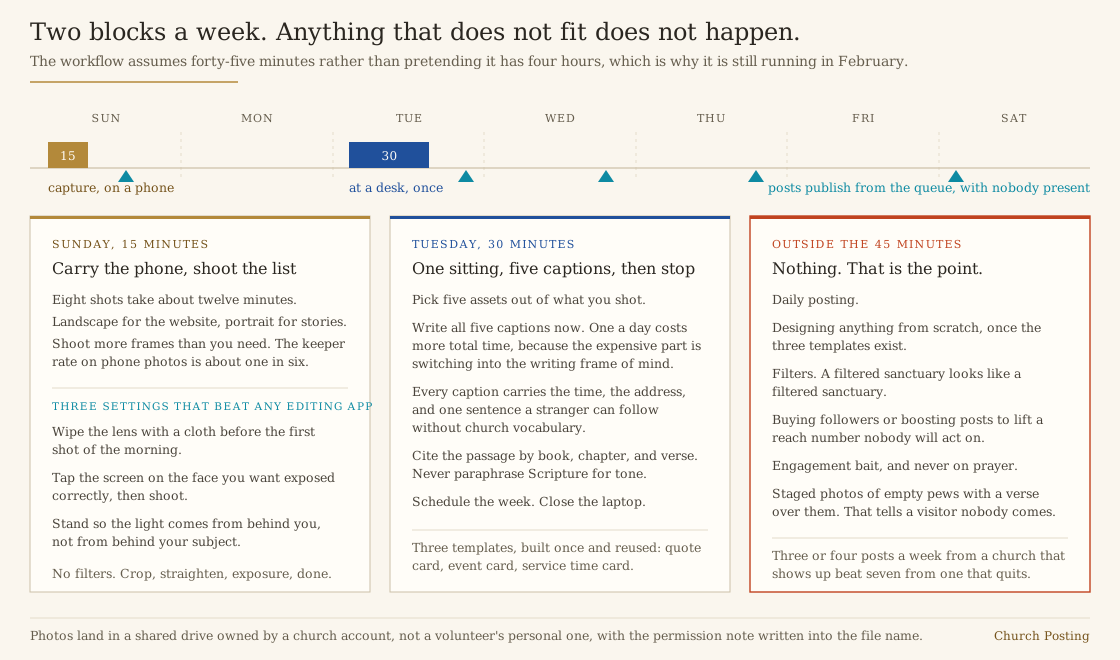
The workflow is one capture session and one desk session a week.
The 45 minute week
- Sunday, 15 minutes of capture. Photos and short clips, on a phone, during the service and after.
- Tuesday, 30 minutes at a desk. Pick five assets, write five captions, schedule the week, close the laptop.
That is the whole job. Anything that does not fit in those two blocks does not happen, and the account survives anyway. Three or four posts a week from a church that shows up beat seven posts a week from a church that quits in February.
The eight shot capture list
Hand this list to whoever carries the phone. It removes the hardest part, which is deciding what to photograph while a service is going on.
- The open Bible or bulletin on someone’s lap, close up, no faces.
- Wide shot of the room from the back, taken during a hymn.
- Hands: passing the offering plate, holding a hymnal, a handshake at the door.
- One musician or reader mid-motion, from the side.
- The welcome table, the coffee, the doughnuts, the name tags.
- Kids’ hallway or check-in area, empty of children’s faces.
- The building exterior with actual weather and actual light, not the same photo from 2021.
- One posed group who said yes: the greeters, the youth after class, the volunteers doing setup.
Eight shots take about twelve minutes. Shoot in landscape for the website and portrait for stories, and shoot more frames than you need. The keeper rate on phone photos is roughly one in six.
Three settings that raise quality more than any editing app: wipe the lens with a cloth before the first shot, tap the screen on the face you want exposed correctly, and stand where light comes from behind you rather than behind your subject.
Batch the captions
Write five captions in one sitting on Tuesday. Writing one caption a day costs more total time than writing five at once, because the expensive part is switching into the writing frame of mind.
Use the four patterns in church social media posts: Sunday invitation, sermon follow up, prayer, hospitality. Rotate them. Every caption needs the time, the address, and one sentence a stranger can understand without church vocabulary.
Cite the passage by book, chapter, and verse. Never paraphrase Scripture for tone.
Free tools that actually cover this
- Meta Business Suite is where you schedule Facebook and Instagram from one browser tab. Meta describes it as the place to “create or schedule posts, stories and ads for your business” (Meta Business Suite). That page prints no price, and Meta has not charged churches for scheduling, so treat it as free and verify on your own account before you depend on it. For most churches this is the entire scheduling stack, and the social scheduling directory covers what the paid tools add if you outgrow it.
- Canva has a free plan that covers text on a photo and simple sermon quote graphics. Canva also advertises a nonprofit program, and its nonprofit page refused every request made while writing this, returning HTTP 403, so nothing here states what that program includes or who qualifies. Apply through Canva directly and read the terms yourself. Build three templates once: quote card, event card, service time card. Never design from scratch again.
- The phone’s own photo editor handles crop, straighten, and exposure. Skip filters entirely. A filtered photo of a sanctuary looks like a filtered photo of a sanctuary.
- A shared Google Drive folder owned by a church account, not a volunteer’s personal account, holds approved photos with a permissions note in the file name.
Paid church specific texting and app tools exist and are worth money once a church is larger. Planning Center People is free with an unlimited database, and the Church Center member app has a free Essential tier, with Plus at $15 a month for custom pages and themes and Premium at $32 a month for audio and video channels (Planning Center pricing, Church Center, both checked 29 July 2026). That is enough for a small church that wants a directory and an app without a bill.
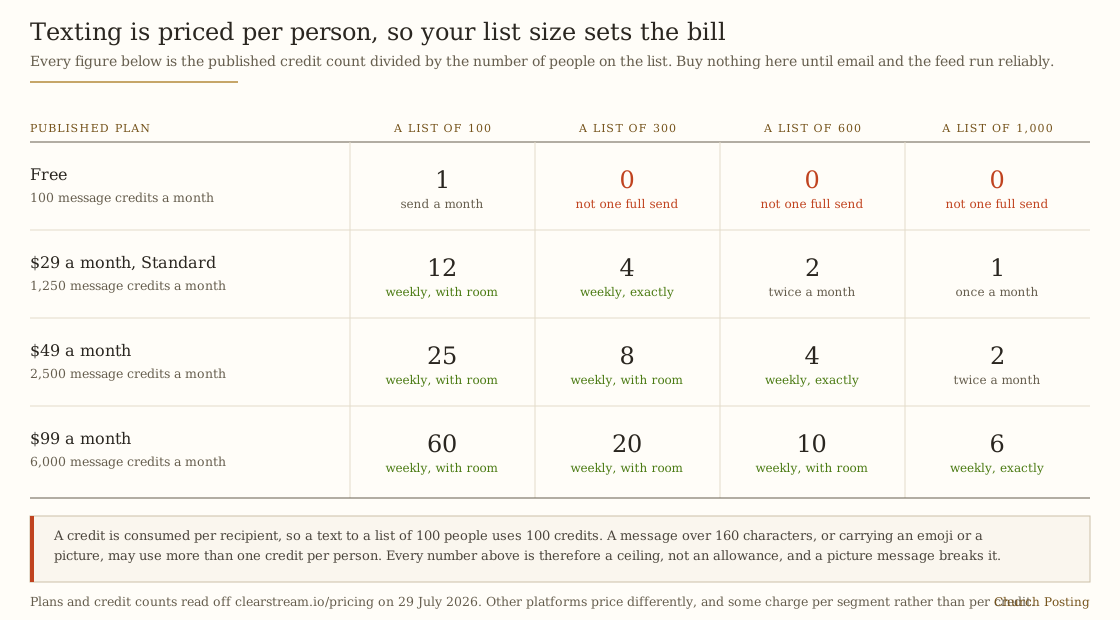
Texting is where cost appears. Clearstream publishes a Free plan at 100 message credits a month and a Standard plan at $29 a month for 1,250 credits, then $49 for 2,500 and $99 for 6,000 (Clearstream pricing, checked 29 July 2026). Credits are consumed per recipient, so “if a text is sent to a list of 100 people, it will use 100 credits,” and a message longer than 160 characters or carrying an emoji or a picture “may use more credits.” A 300-person list therefore burns 300 credits per send, which puts the $29 tier at roughly four plain sends a month. Do not buy texting until email and the feed are running reliably.
The permissions rules
These are not optional, and getting one wrong costs a family’s trust permanently.
Before the list, the honest legal position, because church communications advice usually gets this backwards. There is no single federal statute that forbids a church from posting a photograph of a child on its own Facebook page. The rule people reach for is COPPA, and COPPA does treat a child’s picture as personal information: the regulation’s definition includes “a photograph, video, or audio file where such file contains a child’s image or voice.” But COPPA binds an “operator” of a website or online service, and that definition “explicitly excludes nonprofit entities that are exempt from Federal Trade Commission Act coverage” (16 CFR 312.2). A church posting to its own page is almost certainly outside it.
So the child photo rule below is not federal compliance. It is your policy, adopted because a parent handed you their eight-year-old and because the same regulation that does not bind you still names a child’s photograph as the kind of information that needs a guardian’s permission. Write it as policy, approved by the elders, and it will hold better than a half-remembered legal threat. State law on the use of a person’s likeness varies and is a question for an attorney in your state, not for an article.
- No child’s face and name in the same post, ever, without written permission from a parent. Photograph kids from behind, at a distance, or not at all.
- Keep a photo consent list. A one line question on the membership form and the guest card: may we use photos that include you in church communications, yes or no. Keep the answers in one spreadsheet.
- Ask before posting anyone’s crisis. A hospital photo, a prayer request with a name, a benevolence story. Get explicit permission each time. Prior permission for photos is not permission for this.
- Never post the location of a women’s shelter, a recovery group, or anyone whose safety depends on where they are not. Small groups that meet in homes get the neighborhood, not the address.
- Elders approve anything touching doctrine, money, politics, or a pastoral situation before it posts. Write that rule down so the volunteer can say no by pointing at policy instead of by arguing.
What not to do
Do not chase daily posting. Do not buy followers or boost posts to inflate reach numbers that no one will act on. Do not run engagement bait, and never run it on prayer. Asking people to type “Amen” to be counted turns intercession into a metric.
Do not post staged photos of empty pews with a Bible verse over them. That image tells a visitor the room is empty. Photograph the room with people in it, or photograph something else.
Do not let the account become an announcement board for members. Members need the bulletin, the newsletter, and text. Social is where people who are not yet in the room look you up. Write for them.
What to measure, monthly, in five minutes
Reach and follower counts are close to worthless for a church account. Track three numbers instead:
- Profile visits. People checking whether you are real.
- Clicks to the service times page. The only conversion the feed owes you.
- Direct messages and comments that required a human reply. These are actual people asking actual questions.
If profile visits climb while clicks to service times stay flat, your bio and your pinned post are failing. Fix the bio first: church name, denomination or tradition in plain words, service time, street address, one link.
Handing it off before the volunteer burns out
Every church communications volunteer eventually stops. Plan for it in month one.
Church owned accounts, church owned email, credentials in a shared password manager the pastor can access. Two people on the account at all times, one drafting and one approving. A one page document that lists the posting rhythm, the capture list, the caption patterns, and the approval rule. Recruit the replacement six months before you need them and let them shadow for four weeks.
The rhythm survives the volunteer only if the rhythm was written down. Put it in the same place as the church content calendar, and review both quarterly with an elder.
Two posts carry the parts this one deliberately does not. Church social media strategy is the longer argument about what a church feed is for and what it should refuse to do. A guest follow-up system one volunteer can run is what has to exist before a profile visit turns into a person in a room, and without it the feed produces numbers and nothing else.
Sources
- 16 CFR 312.2, COPPA definitions, via Cornell Legal Information Institute. Checked 29 July 2026.
- Clearstream pricing, plans, credit counts, and credit consumption rules. Checked 29 July 2026.
- Planning Center pricing, free tier limits by product. Checked 29 July 2026.
- Planning Center Church Center, Essential free, Plus $15, Premium $32. Checked 29 July 2026.
- Meta Business Suite. Checked 29 July 2026.
Canva’s nonprofit program page returned HTTP 403 on every attempt, so this post makes no claim about what that program offers or who is eligible.