What actually fills a church calendar
An audit method for church events, how to cost each one in volunteer hours, and the four questions that decide what stays on next year's calendar.
Updated
Most church calendars grow by accretion. A ministry started because one family cared about it in 2014. The family moved in 2019. The event still runs, because removing it feels like a rebuke to people who are no longer there to be rebuked. Ten years of that produces a calendar nobody chose, staffed by the same eleven people, quietly competing with the Lord’s Day for the congregation’s attention.
An audit fixes it in about six hours of work spread over two meetings.
Print the year on one page
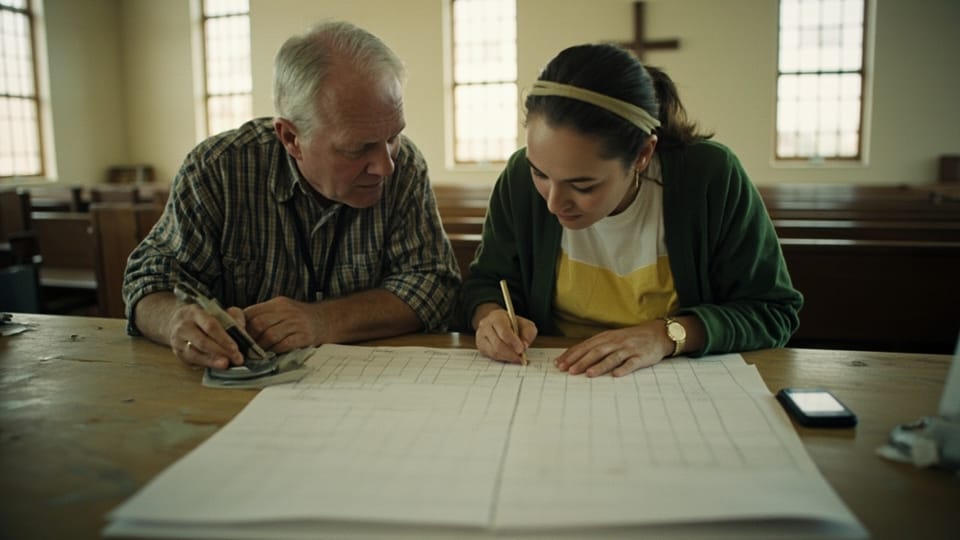
Export the last twelve months from whatever system holds the schedule: Planning Center Calendar, a shared Google Calendar, the office wall calendar, the bulletin archive. Planning Center Calendar has a free tier limited to one room, so a church already inside that ecosystem can pull the history without a bill (Planning Center pricing). If the schedule lives nowhere you can export, that is the first finding, and church event planning software covers what the room-booking tools cost before you buy one to fix it.
Build one row per recurring event and one row per one-off. Columns:
- Event name
- Dates and frequency
- Staff owner
- Volunteer owner (a person, not a committee)
- Attendance, counted
- Volunteers required per occurrence
- Direct cost (food, materials, honoraria, printing)
- Room and setup required
Fill it from records, not memory. Where nobody counted attendance, write uncounted. Uncounted is a finding, not a blank. An event that has run for six years without anyone knowing how many people came is an event no one is accountable for.
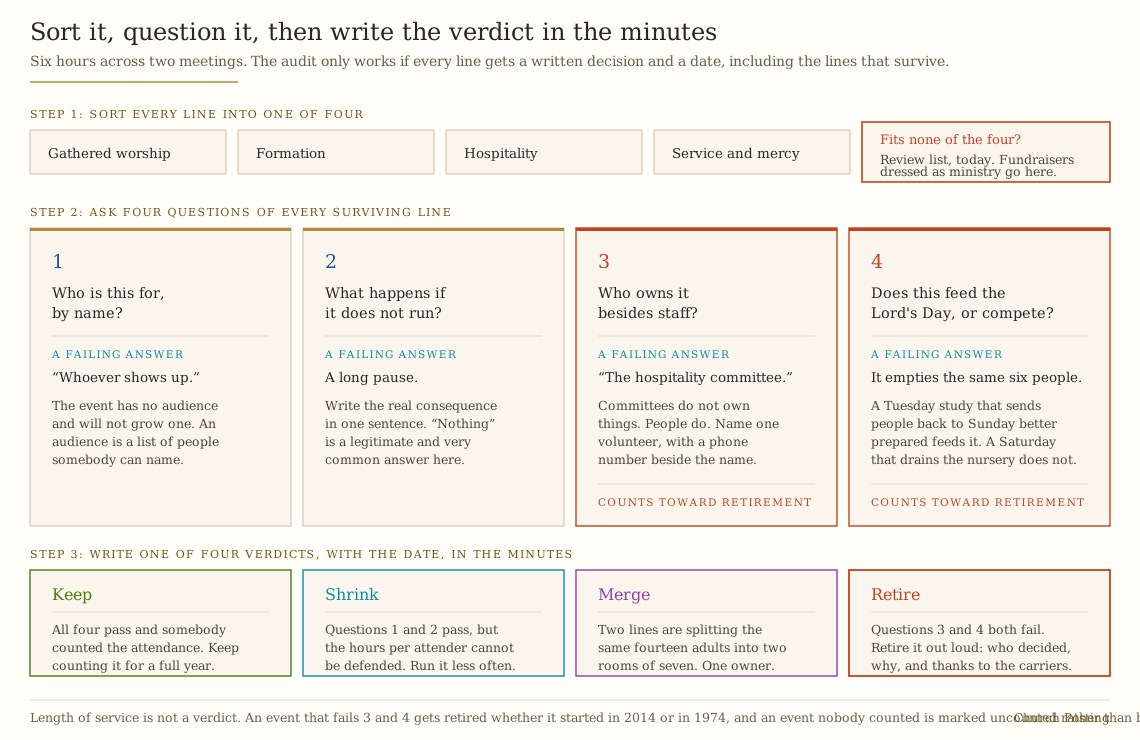
Sort every row into four categories
- Gathered worship. Sunday services, the prayer meeting, funerals, weddings, baptisms, Communion preparation.
- Formation. Catechism, Bible studies, membership class, youth, kids, new believer classes.
- Hospitality. Meals, newcomer lunches, the block party, the meal train for a family with a new baby.
- Service and mercy. Benevolence appointments, the food pantry, hospital and shut-in visits, work days.
Anything that fits none of the four goes on the review list immediately. Fundraisers dressed as ministry belong on that list too. So does any event whose real purpose is to keep a committee busy.
Cost every event in volunteer hours
Dollars understate what events cost a church. Volunteer hours are the scarce resource, and they come out of the same forty people who also usher, teach, cook, and sit on the finance committee.
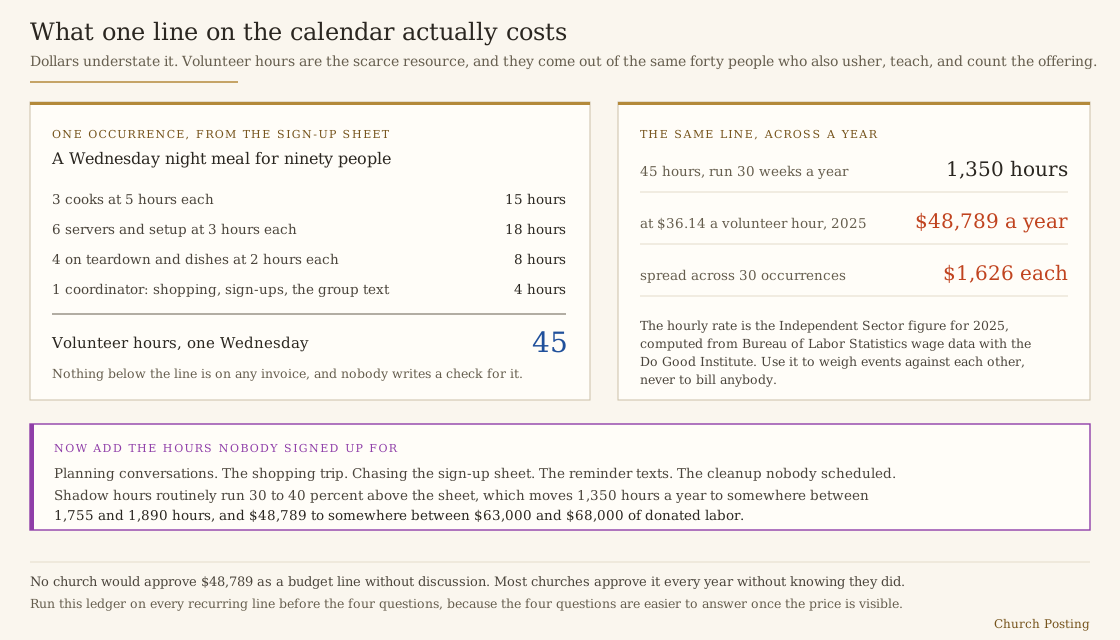
Work the arithmetic honestly. A Wednesday night meal for ninety people:
- 3 cooks at 5 hours each = 15 hours
- 6 servers and setup at 3 hours each = 18 hours
- 4 people on teardown and dishes at 2 hours each = 8 hours
- 1 coordinator on shopping, sign-ups, and the group text at 4 hours = 4 hours
That is 45 volunteer hours per occurrence. Run it thirty weeks a year and the meal consumes 1,350 volunteer hours. That number is the price tag you have been paying without reading it. Now ask what else 1,350 hours could have bought, and decide on purpose.
If the elders need the number in dollars to take it seriously, Independent Sector puts the value of a volunteer hour in the United States at $36.14 for 2025, a figure it publishes annually from Bureau of Labor Statistics wage data with the Do Good Institute at the University of Maryland (Independent Sector, Value of Volunteer Time, announced 21 April 2026). At that rate the Wednesday meal is $48,789 of donated labor a year, roughly $1,626 an occurrence. No church would approve that as a budget line without discussion, and most churches approve it every year without knowing they did.
Use the dollar figure to weigh events against each other, not to bill anybody. The point is that volunteer hours have a market price, and a calendar that spends them carelessly is spending real money.
Count the shadow hours every time: planning conversations, shopping, sign-up chasing, the reminder texts, the cleanup nobody scheduled. Shadow hours routinely run 30 to 40 percent above the hours that appear on the sign-up sheet.
Ask four questions of every line
- Who is this for, by name? If the honest answer is “whoever shows up,” the event has no audience and will not grow one.
- What happens if it does not run? Write the actual consequence in one sentence. “Nothing” is a legitimate and common answer.
- Who owns it besides staff? A named volunteer with a phone number. Committees do not own things. People do.
- Does this feed the Lord’s Day or compete with it? A Tuesday study that sends people back to Sunday better prepared feeds it. A Saturday event that exhausts the same six people who run the nursery competes with it.
The fourth question is the one worth arguing about, because Sunday is no longer a weekly habit for most of the country. Pew Research Center’s 2023 to 2024 Religious Landscape Study, fielded to 36,908 respondents between 17 July 2023 and 4 March 2024, found 33 percent of US adults say they attend religious services at least once a month (Pew Research Center). A calendar built on the assumption that members are in the building three or four times a week is planning for a congregation that mostly no longer exists, and the audit is where you find out.
An event that fails questions three and four should be retired, no matter how long it has run.
What usually survives the audit
Funerals, hospital visits, and benevolence. Membership class. A weekly shared meal that reliably feeds people. Kids and youth programming that runs concurrently with a service that is already happening, which costs a room rather than a whole evening. Vacation Bible School, when the volunteer base is real, because it is one of the few events that puts neighbors inside the building without a sales pitch. See Vacation Bible School themes before committing a summer to one.
What usually dies
The annual banquet that costs 300 volunteer hours and draws people who already attend every week. The second midweek study that split the same fourteen adults into two rooms of seven. The Saturday men’s breakfast with four attenders who would be glad to meet at a diner without the church renting a fellowship hall. Any event whose attendance has fallen for three consecutive years while its volunteer cost held steady.
Retire these out loud. Tell the congregation the event is ending, who decided, and why. An event that silently disappears teaches people that the calendar is arbitrary. An event that is publicly retired, with thanks to the people who carried it, teaches people that leadership is paying attention.
Order of operations
- Pull twelve months of records into one grid. Budget two hours.
- Fill in attendance and volunteer counts. Mark every gap as uncounted. One hour.
- Convert each event to volunteer hours per occurrence and per year. One hour.
- Run the four questions on every line in a staff or elders’ meeting. Two hours.
- Decide keep, shrink, merge, or retire for each. Write the decision and the date in your minutes.
- Announce changes from the front and in the newsletter before the new calendar publishes. See church announcement examples for wording that does not sound defensive.
- Publish the trimmed calendar ninety days out so families can plan.
- Count attendance at every surviving event for a full year. Use the method in measuring attendance honestly.
Protect the empty weeks
Leave weeks with nothing on them. Late August before school starts. The week after Christmas. The week after Easter. Volunteers who have no recovery weeks stop volunteering within eighteen months, and you lose the person, not the event.
A calendar with white space also gives you room to respond. When a family in the church has a crisis, the congregation that has three free evenings can show up. The congregation booked solid can only send a card.
The rule for adding anything new
Nothing enters the calendar without three things: a named volunteer owner, an end date, and a plan for counting attendance. Run it as a six week pilot. At week seven, look at the count and decide with numbers instead of feelings. Most good ideas survive that test. The ones that do not were going to fail in year two anyway, after they had consumed a thousand hours.
Once the calendar is honest, the communications calendar gets easy, because you are only promoting things that deserve promotion. Build that next with the church content calendar, and put the surviving events in front of guests through a guest follow-up system one volunteer can run rather than through another all-church email.
Sources
- Independent Sector, Value of Volunteer Time, $36.14 per hour for 2025, announced 21 April 2026. Checked 29 July 2026.
- Pew Research Center, Decline of Christianity in the US has slowed, may have leveled off, 2023 to 2024 Religious Landscape Study, 36,908 respondents. Checked 29 July 2026.
- Planning Center pricing, free tier limits by product. Checked 29 July 2026.