
Small church bookkeeping, in the order the month has to run
The monthly cycle a church treasurer runs: two counters on the offering, designated funds, the bank reconciliation, and the January statements.
On this page
- The cycle, before any of the detail
- Sunday, and the two people who count
- Monday, the deposit and the number that has to be zero
- Recording it, and where designated giving goes
- Reconciling the bank, and the clock nobody mentions
- How often should a church reconcile its bank account?
- The three reports a board is owed
- Once a quarter, from outside the finance team
- The year-end sequence, in date order
- What has to be on a giving statement
- Do churches have to file a Form 990?
- What this page did not test
- The three files
- Do this before next Sunday
Each month, the bookkeeper reconciles every bank and card account, checks restricted gifts, reviews unpaid bills and prepares fund reports. A second authorized person reviews the reconciliation and supporting records. Close the month after they resolve discrepancies and retain the approved reports.
The October statement is still in its envelope. So is November’s. The treasurer has run the books alone for three years, opens the drawer in February to build something for the annual meeting, finds fourteen unopened envelopes and a bank balance she has never tied to anything, and writes down a figure she cannot defend.
Nothing was stolen. The books stopped being a record and became a drawer, because nobody ever wrote down the order. Each month the work happened in whatever sequence the week allowed, and the two steps that catch errors are always the two that slide.
Below is the order. Eight steps, four of them on Sunday and four in the first week of the following month, plus one quarterly step a bookkeeper cannot perform on herself. Whether you buy software for this is a separate decision, priced out with the fund-report test in church accounting software that keeps designated funds straight. Nothing on this page requires you to buy anything.
The cycle, before any of the detail
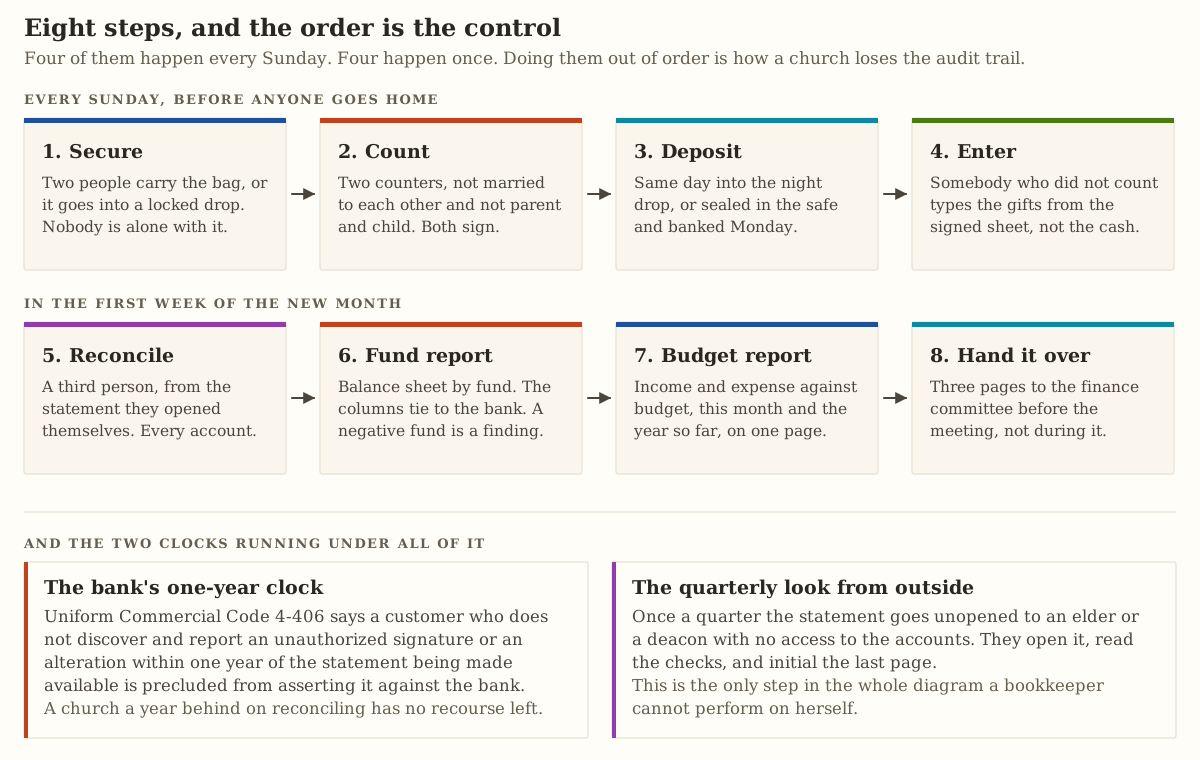
The two halves do different jobs. Sunday is custody. Currency arrives in a bag, no bank has recorded it yet, and until two people have written down the same number it does not exist anywhere. Month-end is proof. The bank has a version of the truth, the ledger has a version, and the close is the exercise of making them the same and then telling a committee what the answer was.
Every step below is either a rule somebody publishes or a practice you can change. Where it is a rule, the source is linked in the sentence that makes the claim and again in Sources. Where it is a practice, this page says so.
Sunday, and the two people who count
Two counters open the bag together. Neither is ever alone with it, including on the walk from the sanctuary to the office. They count in the same room, they fill in one sheet, and they both sign it.
The two counters are not married to each other and not parent and child. That is what “unrelated” means here. Churches skip that part, because the couple who have done it for eleven years are reliable and asking them to split up feels like an accusation.
No federal rule prescribes how many people count a church offering, whatever the pages asserting one imply. The Greater Washington Society of CPAs Educational Foundation, which publishes the nonprofit accounting guidance this page leans on, describes the underlying principle rather than a headcount: “Critical to the implementation of strong internal controls is an appropriate level of segregation of duties. This involves dividing responsibilities among different people to ensure that no one person has too much control over any one aspect of the organization’s finances.” On the disbursement side the same body does put a number on it: “At a minimum an organization should have at least two people involved in this process”, with the signer being somebody other than the person writing the checks.
Two counters is that principle applied to currency, and currency is the reason the number is two rather than one. A check carries a maker, a payee, a number and a bank record, so a check that goes missing leaves a trail in four places. A twenty-dollar bill in a plate leaves nothing. The only record that a particular twenty ever arrived is the sheet two people signed, so the sheet is the control and a single signature on it is no control at all.
ECFA, an accreditation body rather than a regulator, puts the governance half of this on the board. Its Standard 3 requires that boards be informed of “any material weaknesses in internal control or other significant risks,” alongside the requirement that a board or a committee of a majority of independent members “approve the engagement of an independent certified public accountant, review the annual financial statements.” A church with one person handling the whole offering has a material weakness in internal control, whether or not anybody has used that phrase in a meeting.
The count sheet. Download the offering count sheet as a CSV. It runs nine sections: who counted and whether they are related, the denomination grid, twenty check lines with a fund column, the split between named envelopes and loose plate, the fund allocation, the difference line that has to read zero, the deposit record, three signature lines, and a notes block for exceptions. Print one per service. It opens in Google Sheets, Excel, or Numbers, and it prints on one page if you drop the unused check lines.
Two rules on that sheet earn their place and get skipped everywhere. Loose currency cannot appear on anybody’s giving statement, so nobody gets credit in February for an anonymous plate gift however sincerely they remember it. And an envelope whose written amount does not match its contents is an exception with a note beside it, not a discrepancy for somebody to find in nine months.
Monday, the deposit and the number that has to be zero
The count sheet total and the deposit slip total are the same number. If they are not, recount before anybody leaves the room. A difference discovered on Tuesday is unsolvable, because the money and the people who touched it have both dispersed.
Bank the currency the same day where the bank has a night drop. Where it does not, the money stays sealed in the safe with the signed sheet, and it goes in Monday morning with two people in the car. The CPA guidance is blunter than most churches are: “Deposits are made daily,” with checks “immediately endorsed ‘for deposit only account number XXXXXX’”, posted to a check log, and every check log verified against bank records. A church that banks weekly is running looser than that standard, and the reason to know it is that the gap is where the loss lives.
Then somebody who did not count types the gifts into the ledger, working from the signed sheet rather than from the cash. That reversal matters. A person entering gifts while holding the money can make the entry agree with whatever is in their hand.
Recording it, and where designated giving goes
A church has one bank balance and several separate promises about what parts of it are for. The bank tracks the balance and nothing else. Tracking the promises is the ledger’s job, and no part of the deposit does it for the ledger.
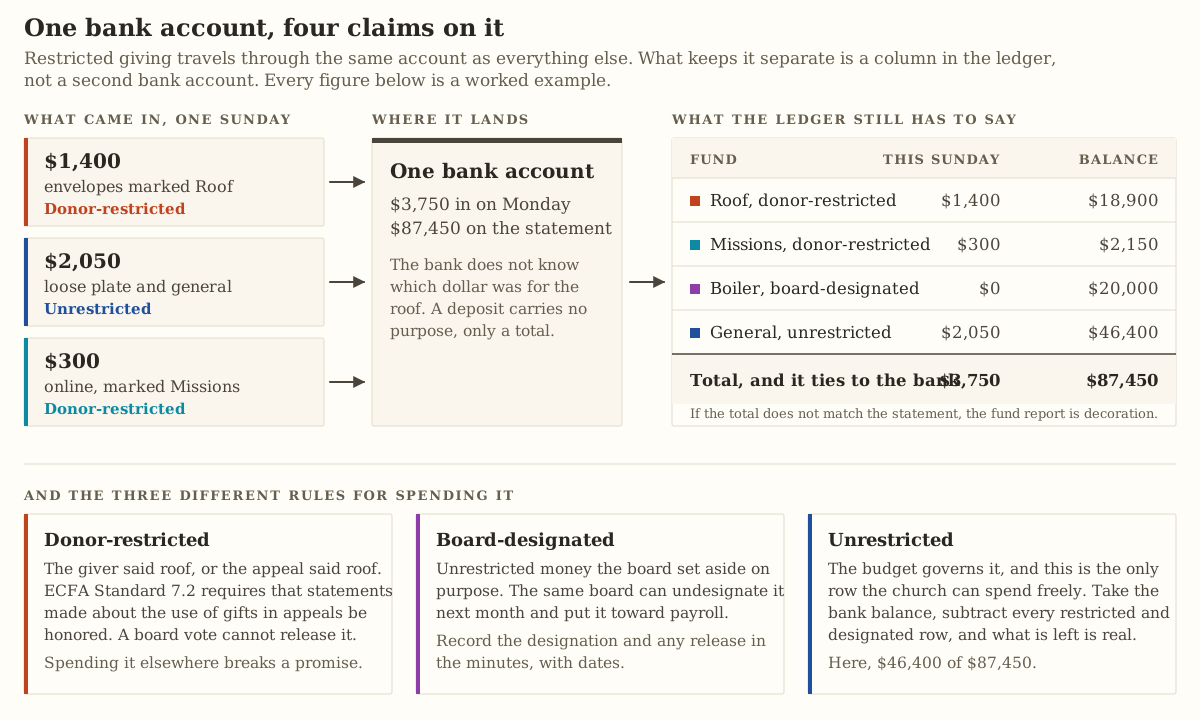
Two kinds of restriction get muddled, and they behave differently when money gets tight, which is exactly when somebody proposes spending them.
Donor-restricted money came with an instruction from the giver, or in answer to an appeal that named a purpose. ECFA’s Standard 7.2 states the duty: “Statements made about the use of gifts by an organization in its charitable gift appeals must be honored. A giver’s intent relates both to what was communicated in the appeal and to any instructions accompanying the gift, if accepted by the organization.” The same standard adds that appeals must “not create unrealistic expectations of what a gift will actually accomplish.” Once the church accepts a gift given for the roof, a board vote cannot turn it into payroll.
Board-designated money is unrestricted money the board decided to set aside. A board that set twenty thousand dollars aside as a boiler reserve can release it at the next meeting and put it toward payroll. Both the designation and any release belong in the minutes with dates, because in three years nobody will remember which of the two kinds the reserve was, and the answer decides whether the church is allowed to spend it.
Keeping them separate takes a column, not a second bank account. A second account doubles the reconciliations and still does not tell you the balance of a fund, because two funds will end up sharing it. What produces an answer is a balance sheet by fund whose columns add up to the cash in the bank, and whether a product can print that on demand is the whole software question. The test to run in a trial, and the prices as at 29 July 2026, are on the accounting software page, and our method for pricing and disqualifying tools is written out at how we review. If the membership roll is in play at the same time, the free tiers and the exact ceilings where they stop are collected in free church management software.
Reconciling the bank, and the clock nobody mentions
The reconciliation is the month’s only independent check, and it fails the moment the wrong person performs it. The standard is stated plainly: “an individual other than the person writing checks and making deposits should reconcile the bank account each month,” with the executive director or the treasurer receiving the unopened statement each month, reviewing every transaction and being confident that all of them are valid. The same guidance elsewhere requires that “bank statements and other correspondence from the bank are reviewed by an individual separated from the processing of activity reported on the bank statements.”
The word doing the work in those sentences is “unopened.” A reconciliation performed on a statement that the bookkeeper printed from online banking herself proves that the ledger agrees with a page she selected. A reconciliation performed on an envelope she did not open proves that the ledger agrees with the bank.
One deadline in this cycle comes from banking law rather than tax law, and it is the reason to close within weeks rather than months. Uniform Commercial Code 4-406 requires that a customer “must exercise reasonable promptness in examining the statement or the items to determine whether any payment was not authorized”, and it ends the argument entirely after a year: “a customer who does not within one year after the statement or items are made available to the customer discover and report the customer’s unauthorized signature on or any alteration on the item is precluded from asserting against the bank.” The same section can cut off a claim far sooner where the bank shows the customer failed the promptness duty and the bank took a loss, extending to further items forged by the same person within 30 days.
Two honest caveats. The Uniform Commercial Code is model text that each state enacts for itself, so the version binding your church is your state’s, and a deposit agreement can set its own notice period. We did not read fifty states for this page. In practice the one-year bar answers the question a treasurer who is eleven months behind is asking, and the answer is that the month about to go out of reach is the one from last February.
How often should a church reconcile its bank account?
Every month, by somebody who does not write checks or make deposits, working from a statement they opened themselves. The Greater Washington Society of CPAs Educational Foundation states that standard directly. Uniform Commercial Code 4-406 supplies the outside limit, precluding a customer who has not reported an unauthorized signature within one year of the statement being made available from asserting it against the bank.
The three reports a board is owed
The close produces three pages, and it produces them before the meeting rather than during it. A committee reading numbers for the first time in the room cannot govern them, and a treasurer who hands out paper at the door has converted oversight into a performance.
The balance sheet by fund. One column per fund, and the columns add up to the cash in the bank. Check that sum first. If the columns do not tie to the statement, nothing downstream on the page is true and there is no point reading the rest.
Income and expense against budget, for the month and for the year so far, on one page. Every line over or under by more than a quarter gets a sentence of explanation ready before somebody asks.
Fund activity, showing what came into and out of each restricted and designated fund. Read it for negative balances before anybody else does. A negative restricted fund means restricted money was spent on something else. The church now owes a fund it cannot borrow from, and no journal entry fixes that.
Those three pages, the reconciliations, the count sheets, and the initialled close checklist go in one folder per month. That folder is the first thing anybody reviewing the books will ask for, and assembling it after the fact takes ten times as long as filing it on the day.
Once a quarter, from outside the finance team
The bank statement goes unopened to an elder or a deacon with no access to the accounts. They open it, read the checks, and initial the last page. That is the whole procedure, it takes fifteen minutes, and it is the only step in the entire cycle a bookkeeper cannot perform on herself.
Review the logins in the same sitting. Who can reach the ledger, the giving platform and the bank, and has anybody on that list left the church? Access outlives involvement by years unless somebody makes a habit of asking. The wider obligations that come with holding member and giving records are set out in protecting member data, and the quarterly access review is the cheapest of them.
Then confirm that every board designation made this quarter is written in the minutes with a date and a dollar figure. A designation nobody recorded becomes a restriction by rumor, and a restriction by rumor is unarguable in a congregational meeting.
The year-end sequence, in date order
Dates below are the federal deadlines for the 2026 tax year, read off IRS pages on 29 July 2026. They move. Check them against the current instructions before you rely on them, and take anything touching a minister’s pay to a CPA who has done clergy returns.
| When | What happens | Where the date comes from |
|---|---|---|
| Before the first affected paycheck | The board designates next year’s housing allowance, in the minutes, with a date | A board action. The IRS requirement and its citation are on the accounting software page |
| Late December | Bank the last deposit of the year and note the date. Chase every unattached gift now | Practice, not a rule |
| Early January | Produce statements, print one, and read the fine print at the bottom | IRS on written acknowledgments |
| 31 January | Form 941 for the fourth quarter | Publication 15 (2026) |
| 31 January | Statements out. A practice, because no federal rule sets this date for the church | Publication 526 (2025) sets the donor’s deadline |
| 1 February 2027 | Copy A of every W-2 and Form W-3 to the Social Security Administration | General Instructions for Forms W-2 and W-3 (2026) |
| 1 February 2027 | Copies B, C and 2 of Form W-2 furnished to employees | Same instructions |
| Whenever you file | E-file if you are required to file at least 10 information returns, counted across all types | Same instructions |
| 30 April, 31 July, 31 October | Form 941 for the first, second and third quarters | Publication 15 (2026) |
| Early July | Check next year’s deposit schedule against the lookback period | Publication 15 (2026) |
The deposit schedule is the item that catches a church whose payroll grew. Publication 15 (2026) sets the test: “if the accumulated employment tax liability during the lookback period is $50,000 or less, you’re a monthly depositor for the current quarter,” the lookback period being “the four quarters in the 12-month period ending June 30 of the preceding year.” A monthly depositor deposits “on or before the 15th day of the following month.” Accumulate $100,000 or more of liability on any day inside a deposit period and the deposit is due the next business day, whatever schedule you were on.
Two of those W-2 dates read oddly and they are correct as published. The 2026 instructions say to “mail or electronically file Copy A of Form(s) W-2 and Form W-3 with the SSA by February 1, 2027,” and that “generally, you must furnish Copies B, C, and 2 of Form W-2 to your employees by February 1, 2027.” The e-file threshold is stated as filing “at least 10 information returns,” which is counted across types, so a church filing eight W-2s and three 1099s is over the line.
What has to be on a giving statement
The IRS states what a written acknowledgment must contain, and the list is finite. It needs the “name of the organization”, the “amount of cash contribution,” a “description (but not value) of non-cash contribution,” a “statement that no goods or services were provided by the organization, if that is the case,” a “description and good faith estimate of the value of goods or services, if any, that organization provided in return for the contribution,” and a “statement that goods or services, if any, that the organization provided in return for the contribution consisted entirely of intangible religious benefits, if that was the case.”
That last clause is the one written for churches and the one software leaves out. Print a real statement in January, turn to the bottom, and read it. If the goods-and-services sentence is missing, find the setting or find another product, because a statement without it is worth nothing to a giver whose return gets examined.
The thresholds sit one layer under that. Publication 526 (2025) states that “if you make a contribution of $250 or more, you must obtain and keep a contemporaneous written acknowledgment (CWA) from the qualified organization,” and defines the timing: the acknowledgment “must be received by you on or before the earlier of: (1) the date you file your original tax return for the year of the contribution, or (2) the due date (including extensions) of your tax return for that year.” Below $250 the donor still needs something. The IRS requires the donor to “obtain and keep a bank record or a written communication from the donee” showing the charity’s name, the date and the amount, and states that personal records are “no longer sufficient to support charitable contributions.”
Read those two rules together and the church’s January deadline appears, without any rule aimed at the church. The donor’s clock runs to the earlier of filing and the return due date, and some of your givers file in early February, so a statement that goes out on 31 January is a practice worth keeping and a statement that goes out in April is a problem you handed to somebody else.
One threshold applies to the church directly. Where a gift buys something back, the IRS requires that “a charitable organization must provide a written disclosure statement to donors of a quid pro quo contribution in excess of $75,” informing the donor that the deductible amount is limited to the excess over the value of what they received and giving a good faith estimate of that value. The stated penalty for failing to do it is “$10 per contribution, not to exceed $5,000 per fund-raising event or mailing.” A banquet ticket, an auction lot and a school tuition discount all land in this rule. An offering does not.
Three mechanical failures break the January run every year, and all three are cheap to catch in a trial. A designated gift has to keep its designation all the way from the giving platform to the statement, so send ten dollars to three different funds in a sandbox and read what comes out. Fee-covered gifts need a decided answer on gross versus net before the first statement prints rather than after three hundred PDFs have gone out, and the arithmetic behind that choice is worked through in what giving platforms cost. And loose currency stays off every statement, because nobody can prove who put it in.
The free statements tool prints a statement for every giver from a spreadsheet of gifts, and it carries the goods-and-services sentence at the foot. Type a giver and three gifts to see one.
Free tool you can try here
See a giving statement
Type a giver and three gifts. The real tool does this for every giver from one spreadsheet.
This free tool is made by Church Posting.
Cedar Hill Baptist Church
Contribution statement for 2026
Michael and Hannah Brooks
| Total gifts | $700.00 |
|---|
The church provided no goods or services in exchange for these gifts, other than intangible religious benefits.
The tool is free, reads your spreadsheet without it leaving your computer and opens with your church name.
Do churches have to file a Form 990?
No. The IRS excepts “a church, an interchurch organization of local units of a church, a convention or association of churches” from the annual information return, along with an integrated auxiliary of a church, a church-affiliated organization exclusively managing funds or retirement programs, and a school below college level affiliated with a church.
The relief comes with a cost. Nobody outside the congregation ever sets a deadline for these books, no preparer ever asks why a restricted balance moved, and no member can pull a public filing to check. Every date in the table above exists because of payroll or because of a donor, and not one of them obliges the fund report to be correct. That job sits entirely with the quarterly review and the finance committee, which is why letting either one lapse costs a church more than it would cost any other kind of nonprofit.
What this page did not test
We did not run this cycle through a live set of church books this month, we did not time it, and we did not audit anybody. The sequence is assembled from federal rules and from guidance published by named bodies, every one of them linked in the sentence that uses it. Any page claiming it stopwatch-tested a treasurer’s month should be asked whose month.
We did not test software against this cycle either. Whether a given product prints a balance sheet by fund, carries a designation from a giving form through to a statement, or produces a W-2 for a worker with no FICA withheld are questions answered in a trial, and the trial script plus the prices as at 29 July 2026 sit on the accounting software page.
We could not find a federal rule, or a statement from a CPA body, prescribing two counters for a church offering. Plenty of pages assert one. The rule above is the segregation-of-duties principle applied to untraceable currency, and it is presented that way rather than dressed up as a regulation. If your denomination publishes a counting standard, that document outranks this page.
We did not read fifty states on Uniform Commercial Code 4-406, and a deposit agreement can shorten the notice period below the uniform text. ECFA’s standards bind only organizations that sought accreditation, so read them as the best available description of adequate oversight rather than as law. ECFA also publishes sample policies on its Articles & Sample Policies page, which is a reasonable next stop if you want somebody else’s wording to start from.
The three files
The offering count sheet, as a CSV. Nine sections, twenty check lines, the fund allocation block, the zero-difference check, and three signature lines including the one for the person who enters the gifts and must not be either counter. Seven standing rules print at the bottom of the sheet so a new counter reads them without being trained.
The month-end close checklist, as a Markdown file. The Sunday loop, the five stages of the close with tick boxes, the quarterly section, and the full year-end sequence with every federal quotation and its source URL beside it. It also carries the table of which job must not be held by the same person as which, which is the page to hand a board that wants to know why you keep asking for another volunteer.
The treasurer’s year, as an ICS file. Imports into Google Calendar, Outlook, or anything else reading iCalendar. The close on the tenth of every month and the deposit date on the fifteenth both repeat through December 2027, the outside review repeats quarterly, and the year-end items carry the IRS source in the event description so the date can be rechecked from inside the calendar.
Do this before next Sunday
Write down four names and check that no two of them are the same person: the two counters, the person who enters the gifts, and the person who reconciles the bank. Then write down a fifth, the elder or deacon who opens the statement once a quarter.
If you cannot fill all five, say so at the next meeting in those words. A church with two counters and nobody independent to reconcile has one control and no second one, and a board that has been told that can decide what to do about it. A board that has not been told will assume the cycle is intact because the reports keep arriving.
Then take the oldest unopened statement out of the drawer tonight and reconcile it. If more than a year has passed since the bank made it available, the recourse under 4-406 has already gone, and knowing that changes what you do next week rather than what you can recover. Whatever you decide about software after that, the shortlist and the current prices are in the money directory.
Sources
Every page below was fetched on 29 July 2026, and every quotation and date above came off the page linked here on that date. Nothing on this page is tax or legal advice for your church.
Substantiation and statements
- What a written acknowledgment must contain, including the intangible religious benefits clause: Charitable contributions: written acknowledgments, Internal Revenue Service. Read 29 July 2026.
- The $250 contemporaneous acknowledgment rule and its timing: Publication 526 (2025), Charitable Contributions, Internal Revenue Service. Read 29 July 2026.
- The bank record requirement for gifts of any amount, the $75 quid pro quo disclosure, and the $10 per contribution penalty capped at $5,000: Substantiating charitable contributions, Internal Revenue Service. Read 29 July 2026.
Payroll and year-end dates
- Monthly and semiweekly deposit schedules, the $50,000 lookback threshold, the lookback period, the 15th-of-the-following-month rule, the $100,000 next-day rule, and the quarterly Form 941 due dates: Publication 15 (2026), Employer’s Tax Guide, Internal Revenue Service. Read 29 July 2026.
- The February 1, 2027 filing and furnishing dates for Form W-2 and the 10-return e-file threshold: General Instructions for Forms W-2 and W-3 (2026), Internal Revenue Service. Read 29 July 2026.
What a church does not file
- The church exceptions to the annual information return: Annual exempt organization return: who must file, Internal Revenue Service. Read 29 July 2026.
Internal controls and reconciliation
- Segregation of duties as a principle: Internal Controls for Small Organizations, Greater Washington Society of CPAs Educational Foundation. Read 29 July 2026.
- Monthly reconciliation by somebody other than the person writing checks and making deposits, and the unopened statement: Bank Reconciliations, same publisher. Read 29 July 2026.
- At least two people in the disbursement process, with the signer separate from the preparer: Writing Checks, same publisher. Read 29 July 2026.
- Daily deposits, endorsing for deposit only, the check log, and review of bank correspondence by somebody separated from processing: Cash, same publisher. Read 29 July 2026.
- The one-year preclusion, the promptness duty, and the 30-day extension for further items by the same wrongdoer: U.C.C. Article 4, Part 4, Section 4-406, Legal Information Institute, Cornell Law School. Read 29 July 2026.
Governance and donor intent
- Board size and independence, approval of the audit engagement, review of annual financial statements, reporting of material weaknesses in internal control, and the duty to honor statements made in appeals: ECFA Standards of Responsible Stewardship, ECFA. Read 29 July 2026.
- Sample policies for churches: Articles & Sample Policies, ECFA. Read 13 October 2026.
Pages cited
- Charitable contributions: written acknowledgments, Internal Revenue Service. Read July 29, 2026.
- Substantiating charitable contributions, Internal Revenue Service. Read July 29, 2026.
- Publication 526 (2025), Charitable Contributions, Internal Revenue Service. Read July 29, 2026.
- Publication 15 (2026), Employer's Tax Guide, Internal Revenue Service. Read July 29, 2026.
- General Instructions for Forms W-2 and W-3 (2026), Internal Revenue Service. Read July 29, 2026.
- Annual exempt organization return: who must file, Internal Revenue Service. Read July 29, 2026.
- U.C.C. Article 4, Part 4, Section 4-406, Legal Information Institute, Cornell Law School. Read July 29, 2026.
- ECFA Standards of Responsible Stewardship, ECFA. Read July 29, 2026.
- Internal Controls for Small Organizations, Greater Washington Society of CPAs Educational Foundation. Read July 29, 2026.
- Bank Reconciliations, Greater Washington Society of CPAs Educational Foundation. Read July 29, 2026.
- Writing Checks, Greater Washington Society of CPAs Educational Foundation. Read July 29, 2026.
- Cash, Greater Washington Society of CPAs Educational Foundation. Read July 29, 2026.
- Articles & Sample Policies, ECFA. Read October 13, 2026.
Church Accountant jobs
Churches have 10 open church accountantjobs on Church Posting , including Finance and Accounting Manager at La Croix Church and Staff Accountant at Christ's Church of the Valley .
More on software
All software articlesClergy housing allowance: how it works and what the church has to do
How a minister's housing allowance works under IRS Publication 517: the three limits on it, the designation a church makes in advance, Social Security and Medicare tax, and the pastor's W-2.
Church live streaming: three setups, the equipment for each and where to send the stream
How to stream a church service with a phone, one camera or several, with the sound feed, the internet speed YouTube asks for, the song license, and two streaming services' prices read October 13, 2026.
Online giving for churches: what each platform costs in fees
Fees read October 13, 2026 for Planning Center, Tithely, Givelify, Subsplash, Anedot, Zeffy and Stripe, worked out in dollars for a church that receives $100,000 a year in online gifts.
The weekly email
Join the list for the weekly email of new articles, free tools and job postings. It has not started sending yet.