Church web hosting is $2.99 in year one and $17.99 in year two
Introductory and renewal prices for fourteen hosts, read on 29 July 2026, the four-year cash total, which free tiers a church is not allowed to use, and who owns the domain.
Updated
Prices read from vendor pages

SiteGround sells its smallest hosting plan to a church for $2.99 a month. Twelve months later the same plan costs $17.99 a month, and SiteGround prints that number on the same card, in the same size, one line down: “Renews at $17.99/mo. Prepaid for 12 months” (SiteGround web hosting, read 29 July 2026). The church that budgeted $36 for the year gets a $215.88 invoice.
This page is the hosting bill and nothing else. Which platform to pick, the five pages a church website needs, and the four maintenance paths are all decided in website options for a small church, and that post owns them. Come back here once you know which path you are on and want to know what it actually costs over four years.
Every figure below was read off the host’s own pricing page on 29 July 2026 and is linked at the claim. Where a figure is arithmetic rather than something printed, the sentence says so and shows the multiplication. Where a host publishes no renewal price, this page says that instead of estimating one.
The renewal price, host by host
Five of the seven paid hosts checked print the renewal rate right beside the introductory rate. Two do not print it anywhere on the page.
| Host and plan | Introductory | Term | Renewal | Renewal on the card |
|---|---|---|---|---|
| SiteGround StartUp | $2.99/mo | 12 months prepaid | $17.99/mo | yes |
| SiteGround GrowBig | $4.99/mo | 12 months prepaid | $29.99/mo | yes |
| Bluehost Starter | $3.99/mo | 36 months | $9.99/mo | yes |
| Bluehost Business | $6.99/mo | 36 months | $13.99/mo | yes |
| Hostinger Premium | $2.99/mo | 48 months | $10.99/mo | yes |
| Hostinger Unlimited | $3.79/mo | 48 months | $16.99/mo | yes |
| DreamHost Web Hosting Launch | $2.89/mo | 12 months | $10.99/mo | yes |
| OurChurch.Com Bronze, annual | $100 billed now | 12 months | $200 a year | yes |
| Namecheap Stellar | $0 for 30 days, then $2.28/mo | not stated | not published | no |
| Christian Web Host cPanel | from $11.99/mo | not stated | not published | no |
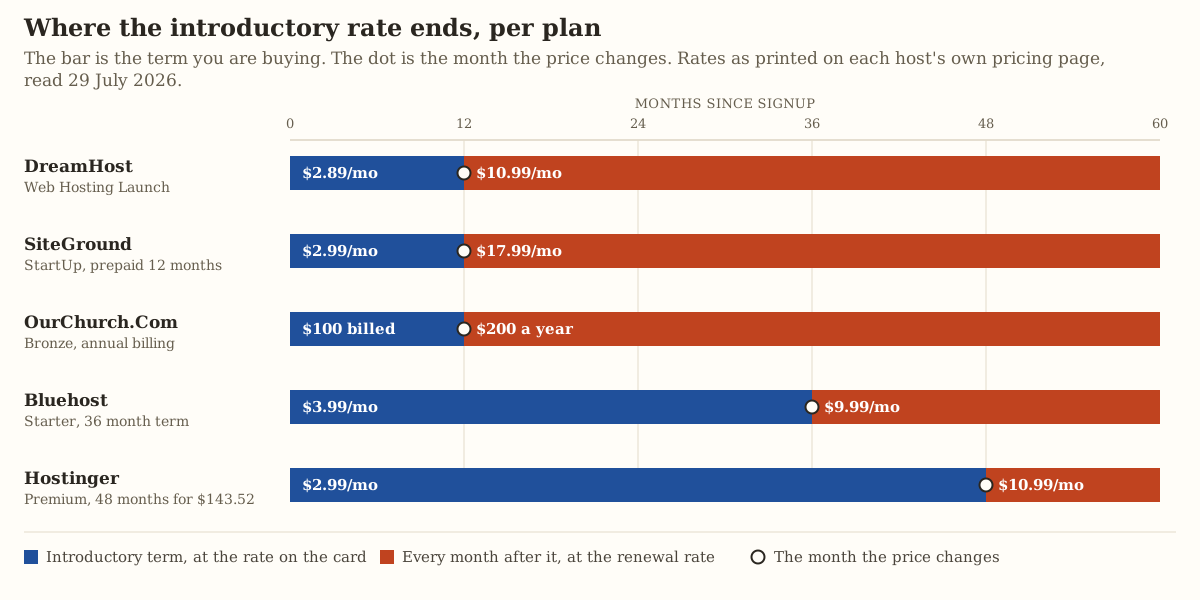
The ratio is the story. SiteGround’s StartUp plan renews at six times the introductory rate. Its GrowBig plan renews at six times as well. DreamHost’s entry plan renews at just under four times. Bluehost’s Starter renews at two and a half times, and Hostinger’s Premium at three and a half.
The percentages each host prints are internally honest, which is worth saying because it is the reason these numbers can be trusted. SiteGround’s StartUp card carries an 83 percent discount badge, and $2.99 against $17.99 is 83.4 percent off. Bluehost’s Starter card says “Save 60%”, and $3.99 against $9.99 is 60 percent off exactly. Bluehost’s Business card says “Save 50%” against a $13.99 renewal, and $6.99 is 50.04 percent off. Those three agree with their own arithmetic, so the renewal figures are not decoration.
The term length matters more than the headline rate
Bluehost’s $3.99 applies to a 36 month term. Hostinger’s $2.99 applies to 48 months, and Hostinger prints the whole-term figure: “Get 48 months for $143.52 (regular price $575.52). Renews at $10.99/mo” (Hostinger web hosting, read 29 July 2026). So the cheapest headline in the set and the longest protection in the set are the same plan, and the price of that protection is that you hand over $143.52 on the day you sign up.
DreamHost and SiteGround sell twelve months. DreamHost’s card reads “First year at $2.89/mo” with “Auto-renews at $10.99/mo after 1 year” underneath (DreamHost shared hosting, read 29 July 2026), and DreamHost is the only host in this set that makes the disclosure a selling point. Its own pricing FAQ answers the question “Will my price go up when my plan renews?” like this: “Promotional pricing applies to your first term, and every DreamHost plan card shows the exact renewal rate right next to the promo price. You will never have to dig through fine print to find out what year two costs.”
That is a fair claim and the page backs it up. It is also an admission of what the rest of the category does.
- SiteGround StartUp renews at month 12
- Bluehost Starter renews at month 36
- Hostinger Premium renews at month 48
- DreamHost Launch renews at month 12
- OurChurch.Com Bronze renews at month 12
Introductory rates, terms and renewal rates read off each host's own pricing page on 29 July 2026 and listed in the table above. The cumulative totals are arithmetic done here, not figures printed by any host. Hostinger's first-year figure of $143.52 is printed on its card; every other total is a multiplication of a printed monthly rate by the number of months, so SiteGround year one is $2.99 x 12 = $35.88 and year two adds $17.99 x 12 = $215.88, Bluehost's flat $143.64 is $3.99 x 36, and OurChurch.Com's $100 and $200 are both printed. Year four for Bluehost and Hostinger assumes the renewal is billed as twelve months at the printed monthly renewal rate, which is an assumption and not a quote. Cloudflare Pages would draw as a flat line on the zero axis for all four years.
See the numbers
| Vendor | 1 yr | 2 yr | 3 yr | 4 yr |
|---|---|---|---|---|
| SiteGround StartUp | $35.88 | $251.76 | $467.64 | $683.52 |
| Bluehost Starter | $143.64 | $143.64 | $143.64 | $263.52 |
| Hostinger Premium | $143.52 | $143.52 | $143.52 | $143.52 |
| DreamHost Launch | $34.68 | $166.56 | $298.44 | $430.32 |
| OurChurch.Com Bronze | $100 | $300 | $500 | $700 |
Three things fall out of that chart.
The cheapest year one is close to the most expensive year four. DreamHost takes $34.68 for the first twelve months, the lowest first payment of any paid host here, and by the end of year four the same plan has taken $430.32. Hostinger takes four times as much on day one and $143.52 total across the same four years.
The loudest discount is the worst four-year deal. SiteGround’s 83 percent badge is the largest in the set and its four-year total is $683.52, nearly five times Hostinger’s, because the discount lasts twelve months and the renewal is the highest in the category.
A church-specific host is not automatically the expensive one. OurChurch.Com’s Bronze plan at $100 for the first year and $200 a year after it lands at $700 over four years, above every general host in the chart, and it is the only one of the five that includes a builder, church-specific themes and an installed certificate in the price. Bluehost’s four-year total of $263.52 averages $65.88 a year and OurChurch.Com’s $700 averages $175, so the church-specific option costs $109 a year more across those four years. Both averages are our division. Whether that $109 is worth paying depends entirely on whether somebody at the church would otherwise be maintaining WordPress, which is the question website options for a small church settles.
One host’s arithmetic does not agree with itself
Hostinger’s Premium card prints three numbers: $2.99 a month, “Get 48 months for $143.52 (regular price $575.52)”, and “Renews at $10.99/mo”. The first two agree, because $143.52 divided by 48 is exactly $2.99. The third does not fit the second. Dividing $575.52 by 48 gives $11.99 a month, and multiplying the printed renewal rate of $10.99 by 48 gives $527.52. Both of those are arithmetic done here rather than figures Hostinger printed.
So the struck-through comparison price on that card is built on a rate of $11.99 a month, a dollar above the renewal rate the same card advertises. Neither number is wrong on its own. Budget against the $10.99 that the card commits to, and treat the $575.52 as marketing furniture.
Which hosts do not print year two
Namecheap. The Stellar card reads “Free trial $0.00 for 30 days” and then “Then $2.28/mo”, beside a “61% off” badge (Namecheap hosting, read 29 July 2026). Stellar Plus reads $2.98 with a 62 percent badge and Stellar Business reads $4.98 with a 58 percent badge. The card states a discount percentage and never states the price the discount is taken off, so nothing on the page tells a reader what the plan costs once the introductory period ends. The page does warn that the trial is not a loophole: “Trial subscriptions are considered a regular purchase so no introductory offers may be used for renewals after the trial period ends.” It also states, usefully, that “Namecheap does not charge an additional fee to transfer an existing website”.
Christian Web Host. The homepage prices a Web Builder plan “Starting at $4.99 /mo.” and a cPanel plan “Starting at $11.99 /mo.” (Christian Web Host, read 29 July 2026). The word “renew” appears once on the page, about SSL certificates, and nowhere about the hosting price.
Squarespace and Wix. Neither served a single plan price to a plain fetch on 29 July 2026. Squarespace’s pricing page returned the plan names and the promotional furniture around them, including “Take 20% off any new website plan” and “Free for 14 days. Pay annually to save up to 36%”, and no dollar figure attached to Personal, Business, Commerce or Advanced Commerce (Squarespace pricing). Wix’s plans page returned the free-domain voucher terms and no plan price (Wix plans). The voucher terms are worth reading before you accept one, because they define the trap in the next section: the voucher “is only included with the first time purchase of a Premium plan. It is not included when renewing a plan or upgrading an existing plan”, it “cannot be used to renew an existing domain”, and it is “redeemable within 60 days following your purchase”.
The Church Co. Its pricing page served the setup packages and not the subscription. The setup tiers are a free “Simple” option, $299 for Essentials, $799 for Tailored and $999 for Custom, and the free one carries a condition printed under it: “Simple Free 1 Year Contract”, described elsewhere on the page as “Free with Yearly Subscription” (The Church Co pricing, read 29 July 2026). This site has read the subscription tiers separately and they are in the price book attached to what church software costs. A free build on a twelve month contract is a build you have paid for in the subscription, which is a reasonable trade and not a gift.
The free tiers, and the two a church is not allowed to use
A five page church site is a few hundred kilobytes of text and images. Four platforms will serve that for nothing. Two of them have terms that a church should read before it puts a giving link on the page.
Cloudflare Pages is the cleanest free tier in the category. Cloudflare’s own documentation states that “requests to static assets are free and unlimited”, and the 100,000 requests a day quota applies to Pages Functions and Workers rather than to plain pages (Cloudflare Pages Functions pricing, read 29 July 2026). If a church ever needs the paid tier, the Workers Paid plan carries “a minimum charge of $5 USD per month for an account” (Cloudflare Workers pricing, read 29 July 2026). Nothing on either page restricts the use to non-commercial purposes.
Netlify’s free plan is now metered in credits, and the ceiling is lower than it looks. The Free plan is “$0 forever” with a “300 credit limit” a month. Production deploys cost “15 credits each” and bandwidth costs “20 credits per GB” (Netlify pricing, read 29 July 2026). Dividing 300 by 15 gives 20 production deploys a month, and dividing 300 by 20 gives 15 GB of bandwidth a month, and those two divisions are arithmetic done here rather than limits Netlify prints. They also compete for the same 300 credits, so a month of frequent edits eats the bandwidth allowance. Fifteen gigabytes is fine for a text site and it is not fine for anything that serves its own sermon audio or a sermon video file, which is a separate hosting decision covered in church live streaming setup. The next tier up is Personal at $9 a month with 1,000 credits, then Pro at $20 a month.
Vercel’s free plan excludes a church that asks for money. Vercel’s fair use guidelines are explicit: “Hobby teams are restricted to non-commercial personal use only. All commercial usage of the platform requires either a Pro or Enterprise plan.” Commercial usage is defined as “any Deployment that is used for the purpose of financial gain of anyone involved in any part of the production of the project, including a paid employee or consultant writing the code”, the listed examples include “Any method of requesting or processing payment from visitors of the site”, and a note under the list states plainly that “Asking for Donations fall under commercial usage” (Vercel fair use guidelines, read 29 July 2026). A church website with a Give button is therefore commercial usage under Vercel’s own definition, and so is a site a church paid somebody to build. The honest price of Vercel for a church is the Pro plan at $20 per user per month (Vercel pricing, read 29 July 2026), which makes it the most expensive option on this page for five static pages.
GitHub Pages is a narrower restriction than Vercel’s and worth reading in full. GitHub states that Pages “is not intended for or allowed to be used as a free web-hosting service to run your online business, e-commerce site, or any other website that is primarily directed at either facilitating commercial transactions or providing commercial software as a service”, and that Pages sites “shouldn’t be used for sensitive transactions like sending passwords or credit card numbers”. The published ceilings are a 1 GB source repository, a 1 GB published site, a “soft bandwidth limit of 100 GB per month” and a “soft limit of 10 builds per hour” (GitHub Pages limits, read 29 July 2026). A church website is not primarily directed at facilitating commercial transactions, so the ordinary case reads as permitted. A giving page that hands off to a third-party processor sits closer to the line, and the sensible reading is to keep card entry off the domain entirely, which is what every giving platform does anyway and which is priced in what giving platforms actually cost your church.
One more thing this page will not claim. Free-for-nonprofit hosting programs exist, and the one with public terms that came up on this run does not fit an ordinary congregation. Cloudflare’s Project Galileo provides Business-plan protection at no cost to organizations working in “human rights, civil society, journalism and democracy”, and asks applicants to explain “how your organization serves the public interest” and the “factors that make it a vulnerable target” (Project Galileo, read 29 July 2026). Churches are neither named as eligible nor excluded. A congregation under genuine threat should apply and say so. A congregation that wants a cheaper website should not.
Who owns the domain, which is where churches actually get hurt
The hosting bill is recoverable. A lost domain name is not always recoverable, and the cost of losing one is every printed bulletin, every sign, every business card and every inbound link the church has ever accumulated.
Four separate things have to be held somewhere: the domain registration, the DNS records that point the name at the site, the website files, and the email on the domain. A church that lets one supplier hold all four has handed that supplier a renewal negotiation it cannot walk away from.
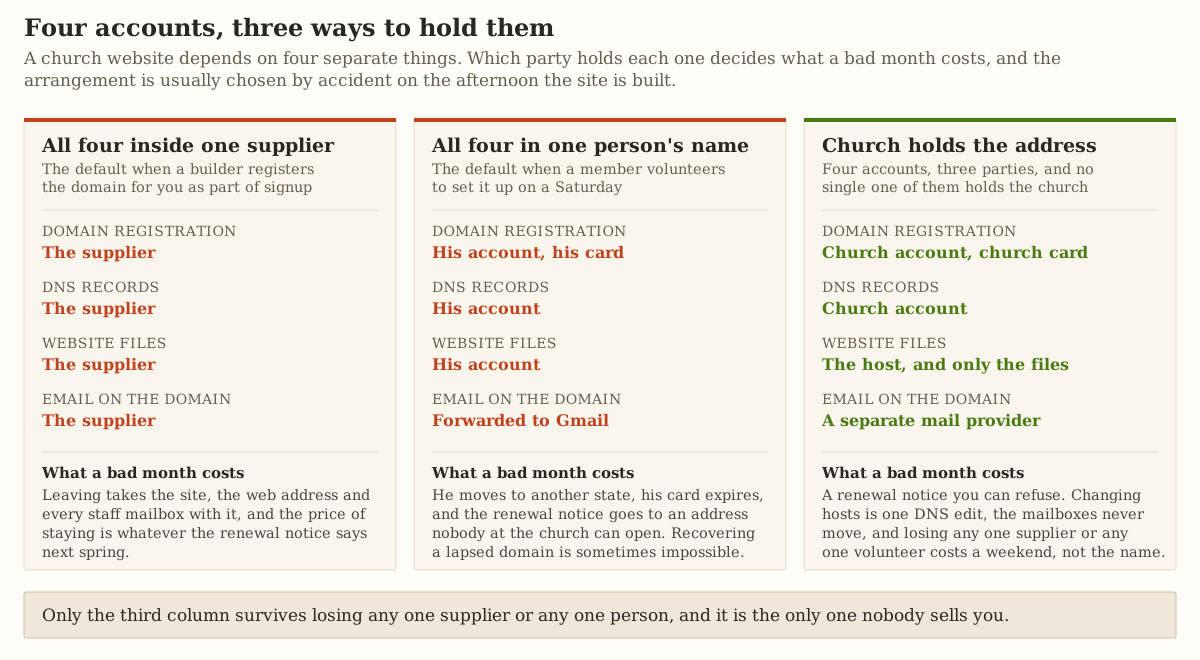
Three rules make the third column real.
Register the name in an account the church owns, and check the registrant field. Not the youth pastor’s personal account, not the designer’s reseller account, not the builder’s bulk account. The billing card belongs to the church, the login lives in the church password vault beside every other account on the list in protecting the data a church holds about its members, and two people can sign in.
If the name is currently in the wrong name, fix it, and opt out of the lock while you do. ICANN’s Transfer Policy requires a registrar to refuse a transfer where “The Registrar imposed a 60-day inter-registrar transfer lock following a Change of Registrant, and the Registered Name Holder did not opt out of the 60-day inter-registrar transfer lock prior to the Change of Registrant request” (ICANN Transfer Policy, section 3.8.5, read 29 July 2026). The opt-out is only available before the change, so a church that moves the registrant name into its own name and then tries to move registrars in the same week discovers a two month wait it could have avoided with one checkbox. The same policy blocks a transfer “requested within 60 days of the creation date” of the name and within 60 days of a previous transfer, at sections 3.7.5 and 3.7.6.
Know which refusals are not allowed. The same policy lists the instances when a transfer “may not be denied”, and the first is “Nonpayment for a pending or future registration period”, at section 3.9.1. A supplier telling a church it cannot take its domain until it pays for next year is describing a refusal the policy does not permit. Section 3.9.3 adds that a registrar lock is not grounds either, “unless the Registered Name Holder is provided with the reasonable opportunity and ability to unlock the domain name prior to the Transfer Request”.
Two things about the free domain that hosts bundle with year one. Bluehost’s terms state that “After the first year, the domain will automatically renew at the then current rate (located in your renewal center) until cancelled”, and that “Any domains cancelled within the 1st year of service will be assessed a non-refundable domain fee based on the standard cost for the domain, plus any other applicable fees” (Bluehost shared hosting, read 29 July 2026). A rate located in your renewal center is not a rate on a page you can compare. And a newly registered name cannot leave for sixty days regardless of who registered it, per the ICANN sections above.
If the point is to keep the domain bill honest and small, Cloudflare Registrar publishes the clearest position in the category: “Cloudflare Registrar does not mark up domain prices at all. Cloudflare ensures customers only pay the price charged by registries and ICANN for domain registration and renewal, eliminating extra fees when buying a domain” (Cloudflare Registrar, read 29 July 2026). A registrar that cannot raise the renewal price above the registry’s own is a registrar with nothing to negotiate about, which is the property you want in the one account you can never afford to lose.
What was not tested
No church website was migrated for this page and no account was opened. Every figure here is a published price read off a vendor page on one day, and there are three things a desk cannot establish that a reader should treat as open questions.
The first is what a renewal invoice actually says. The renewal rates above are the rates the hosts advertise for renewal. Whether the invoice that arrives in month thirteen matches them, and whether a phone call moves the number, is something only a church with an invoice in hand can report.
The second is migration difficulty. Namecheap states it charges no fee to transfer an existing site, and the other hosts’ migration terms were not read for this page. Nobody here has moved a WordPress site between two of these hosts and timed it.
The third is the credit model on Netlify. The 20 deploys and 15 GB figures are division, not measurement. A real month of a real church site on that plan would settle it, and until somebody runs one, treat those two numbers as the shape of the limit rather than the limit.
Anyone who publishes a hosting comparison implying they ran all fourteen is telling you something they did not do. This page did the reading, showed the arithmetic, and marked the seams.
The two files
The hosting price table, 29 July 2026 is every plan read for this page as one row: host, plan, introductory price as printed, introductory term, renewal price as printed, whether the renewal price appears on the pricing page at all, the first payment, where that first-payment figure came from, the source URL and the date read. Thirty-six rows across fourteen suppliers, including the rows that say a renewal price is not published. The “where the first payment figure came from” column separates quotes from arithmetic on every line, so you can throw out the derived ones if you only trust printed numbers.
Where the church website lives is a one page paper record for the four accounts: registrar, DNS, host, email, with a line for the date the introductory term ends and a line for the renewal price in writing. It ends in four yes or no questions about whether the church could get into each account if the person who built the site stopped answering the phone. Print it, fill it in by hand, and keep it with the insurance policy. It is worth more than the website.
The decision
If nobody at the church will maintain software, put five static pages on Cloudflare Pages and pay nothing but the domain. It is the only free tier here with no non-commercial restriction, its documentation says static asset requests are free and unlimited, and the four-year hosting cost is zero. The price is that a non-technical volunteer cannot edit it, which is a real cost and is the trade website options for a small church walks through.
If a named person will maintain WordPress, take the longest term you can pay for in one payment, and take Hostinger’s 48 months at $143.52 over SiteGround’s twelve at $35.88. The four-year totals are $143.52 against $683.52 and the difference is $540, which is a photocopier lease. Bluehost’s 36 months at $3.99 is the same argument one year shorter. Do not take the twelve month offer from any host whose renewal is more than four times its introductory rate unless you have decided you are leaving at month thirteen, and write that date in the calendar the day you sign up.
If the church wants somebody else to hold the whole thing, price OurChurch.Com’s published $200 a year against a bundled builder and read the contract term first. OurChurch.Com prints its renewal. Two of the church-specific suppliers checked here do not print a renewal price at all, and one bundles a free build with a twelve month contract. A supplier that will not print year two on its own page is telling you what the year two conversation will be like.
Whichever way it goes, do the domain part today, before the hosting decision. Move the registration into a church account with a church card and two named officers, ask the registrar to waive the 60-day lock before you submit the change rather than after, and write the four accounts down on paper. Everything else on this page is money. That part is the name.
The same discipline applied to every other supplier the church pays is the export test in choosing church management software, and the question is identical in both places: what can we take with us, and who has to agree.
Sources
Every price above was read off the page below on 29 July 2026. Hosts change introductory and renewal rates on their own schedule, and an introductory rate in particular is a campaign rather than a price, so open the page before you budget.
- SiteGround web hosting. StartUp $2.99/mo renewing at $17.99/mo, GrowBig $4.99 renewing at $29.99, GoGeek $7.99 renewing at $44.99, each “Prepaid for 12 months”. Read 29 July 2026.
- Hostinger web hosting. Premium $2.99/mo, “Get 48 months for $143.52 (regular price $575.52). Renews at $10.99/mo.” Unlimited $3.79 renewing at $16.99, Cloud Startup $7.99 renewing at $25.99, free domain for one year on each. Read 29 July 2026.
- Bluehost shared hosting. Starter $3.99/mo on a 36 month term renewing at $9.99/mo, Business $6.99 renewing at $13.99, eCommerce Essentials $14.99 renewing at $21.99, plus the free-domain and cancellation terms quoted above. Read 29 July 2026.
- DreamHost shared hosting. Web Hosting Launch first year at $2.89/mo auto-renewing at $10.99/mo, DreamPress 1 at $14.99 renewing at $19.99, VPS Business at $13.75 renewing at $31.99, free one year domain registration on annual plans, and the renewal FAQ answer quoted above. Read 29 July 2026.
- Namecheap hosting. Stellar, Stellar Plus and Stellar Business at $0.00 for 30 days then $2.28, $2.98 and $4.98 a month, with 61, 62 and 58 percent discount badges and no undiscounted price on the card. Read 29 July 2026.
- OurChurch.Com church website hosting. Half off the first payment. Bronze $10.00/mo renewing at $20.00, annual $8.35/mo billed $100 renewing at $200.00, triennial $7.10/mo billed $255 renewing at $510.00; Silver and Gold annual billed $135 and $180 renewing at $270.00 and $360.00. Read 29 July 2026.
- Christian Web Host. Web Builder from $4.99/mo, cPanel from $11.99/mo, no renewal price stated for either. Read 29 July 2026.
- The Church Co pricing. Setup packages free, $299, $799 and $999, with the free tier carrying a one year contract. Subscription prices did not render to a plain fetch. Read 29 July 2026.
- Cloudflare Pages Functions pricing. Free plan, 100,000 requests a day shared with Workers, “requests to static assets are free and unlimited”. Read 29 July 2026.
- Cloudflare Workers pricing. Paid plan at “a minimum charge of $5 USD per month for an account”, free plan at 100,000 requests a day. Read 29 July 2026.
- Cloudflare Registrar. At-cost registration and renewal, no markup, quoted above. No example price printed on the page. Read 29 July 2026.
- Netlify pricing. Free at $0 with a 300 credit monthly limit, Personal $9 a month with 1,000 credits, Pro $20 a month with tiers from 3,000 to 20,000 credits, production deploys 15 credits each, bandwidth 20 credits per GB. Read 29 July 2026.
- Vercel fair use guidelines. Hobby restricted to non-commercial personal use, commercial usage defined, and donations named as commercial usage. Read 29 July 2026.
- Vercel pricing. Hobby free for personal non-commercial use, Pro $20 per user per month with $20 of included usage credit, Enterprise on quote. Read 29 July 2026.
- GitHub Pages limits. Prohibited uses quoted above, 1 GB source repository, 1 GB published site, 100 GB monthly soft bandwidth limit, 10 builds an hour soft limit, 10 minute deployment timeout. Read 29 July 2026.
- Squarespace pricing. Plan names and promotional terms served, no plan price served to a plain fetch. Read 29 July 2026.
- Wix plans. Free domain voucher terms served, no plan price served to a plain fetch. Read 29 July 2026.
- ICANN Transfer Policy. Sections 3.7.5, 3.7.6, 3.8.5, 3.9.1 and 3.9.3, quoted above. Read 29 July 2026.
- Cloudflare Project Galileo. Eligibility described as human rights, civil society, journalism and democracy, with no mention of religious organizations either way. Read 29 July 2026.
Nothing here is tax or legal advice, no host in this piece paid for a place in it, and no link on this page is an affiliate link. That last sentence is the reason the renewal column exists, because an affiliate paid per signup has no reason to print it.